
I had to take the front wheel off my Monster 1100S so I could get a new tyre fitted so thought I may as well remove the forks and change the oil in them as well. I don't need to do the oil seals as they're not leaking and the dust seals are all in good order but although the bike has a full service history (it's a 2009 model, had one previous owner from new for the first 10 years and me for the last 2 years) I have no idea when the oil in the forks was last changed; certainly I didn't do it at the last service. I've done Showas before but Ohlins are a little different in the way their assembled, easier to do on your own at least (so I now know).
First I dropped the forks out of their clamps, then having access to the fork model number, it's on the inside face of the bottom of the fork where the caliper mounts I thought I'd be able to get a service manual from Ohlins .
.

Not on your life. FG7380 is not listed on the Ohlins website . A bit more research and it becomes apparent that the Ohlins forks Ducati buy, and bear in mind these would have been used on all S and R models from that era are made specifically for Ducati and when it comes to servicing them Ohlins will only point you in the direction of your local Ducati dealer or your local Ohlins suspension centre, they will not provide the general public a service manual or parts diagram for forks.
Fortunately I have a Ducati workshop manual for the bike and fortunately it carries a detailed description of how to strip and service the forks with step by step colour photos. Unfortunately, as I later found out, the internals of the forks on mine bear no relation to the internals of the forks as described and photographed in the workshop manual  .
.
A bit of research on YouTube and I found these two videos that I thought were helpful, each just 15-20 mins long.
Now for mine. However, before that, just an aside, I had always had a strange clunking sound that came from the front end of the bike when I went over bumps. I just couldn't identify where it was coming from, I even rode the bike without a helmet to try and hear it better and also had Mrs P walk alongside me as I rode up the road at walking pace finding every bump and pothole I could. All we could guess was that it wasn't the brakes or the headstock but somewhere inbetween, possibly inside the forks, or one of them. As soon as the forks were out of the bike it was apparent there was an issue with the right hand fork. For a start I could extend it to 160mm when the max fork travel is supposed to be 140mm and secondly if you extended it by hand and released it would spring back up as though there was a vacuum inside pulling it back to the 140mm length and when pulled out and pushed back it would make the clunking noise I'd been able to hear. Something was amiss inside that fork leg.
Strip down time to see what's going on.
First the fork cap is undone, (I got an Ohlins fork cap removal tool from GB Motorcycle Products), then it's a case of pushing down the spring and washer to get a 17mm spanner onto the lock nut for the rebound adjuster.
The first thing that hit me was the smell, it was like rotten eggs, I dread to think how long the oil has been inside there, quite probably since it left the Ohlins factory in 2008 . So. locknut held, another 17mm spanner can be used to undo the rebound adjuster and remove the fork cap. Now the washer can be held down to take pressure off the rebound locknut and the locknut undone. However, first I measured the distance the locknut was down the thread, in this case, left hand fork, 25mm. (NB although the distance in this case was 25mm I noticed the locknut had not been turned all the way down to the bottom of the thread which I now know is where it should be when they are reassembled.) Once the locknut is off, the washer can be removed and the spring and damper rod can be pulled out. Now the fork can be turned upside down to empty out the oil. Jeez, the colour of it . Not only does it stink but its like treacle. If I didn't know better I'd say it was engine oil, not fork oil. When I serviced the forks on my 20 year old 748 (which had never been done before - but then it's only done 3,500 miles) it wasn't anywhere near this bad.
400ml of filthy dirty oil, just as it should be - volume wise.
When the fork is turned upside down there are a few other bits that fell out, another washer (no mention of that in either of the two videos linked to above), a white plastic spacer, a metal spacer with a plastic seal on it, the rebound needle and spring.
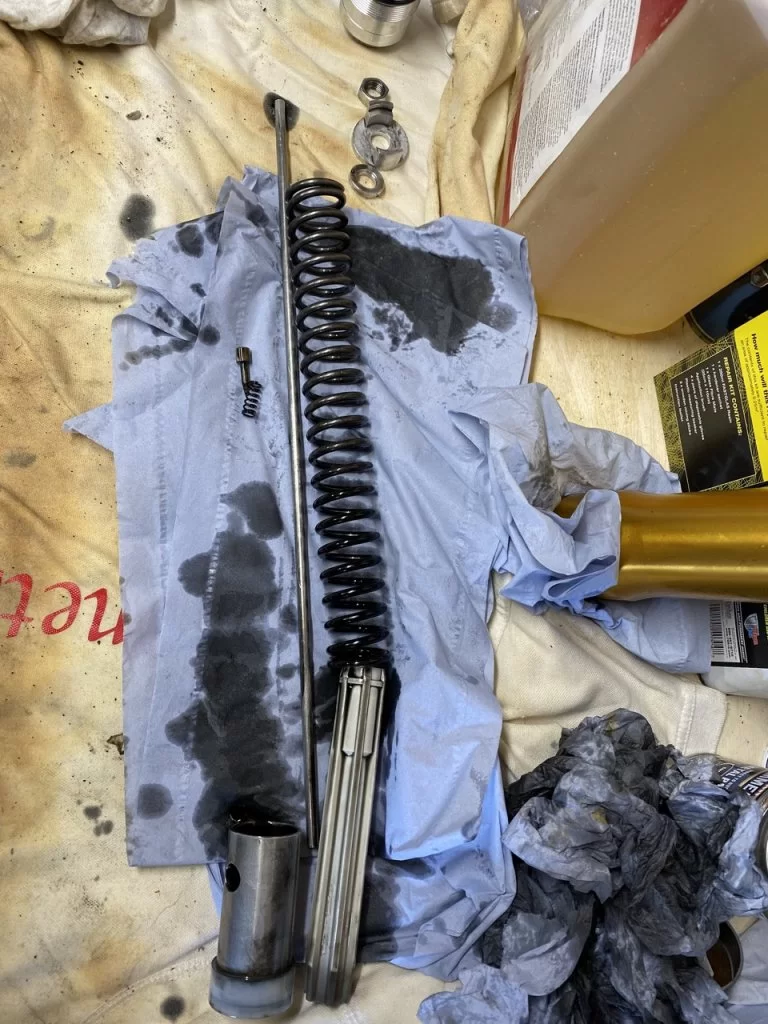
It's now looking like the Exxon Valdez disaster on my workbench, however, the left hand fork is now completely disassembled and left upside down for the remaining oil to drain out overnight.
Now for the right hand fork, the one that makes the clunking noise.
Same procedure, unthread the fork cap, but this time, something's different. The fork cap comes off completly, it's not been threaded onto the rebound damper. WTF . Someone must have been in here before, yet the state of the oil would seem to dispute that. Additionally whereas the locknut on the LH fork had been threaded 25mm onto the adjuster rod the RH one barely made 19mm. I really cannot believe this is how it was assembled by Ohlins in their factory. Also, this one has a circlip installed in a groove on the rebound rod which is retaining the washer and plastic spacer. A quick check of the dismantled LH fork reveals a groove for same but there was no circlip, the washer and white plastic spacer just tipped out when the fork was inverted to drain the oil. I even rummaged around in the old oil just in case but it definitely isn't there. So, I've got a RH fork leg where the fork cap was not connected to the rebound rod and a LH fork leg where there's a missing circlip and the washer and plastic spacer could float freely in the oil. Deffo, someone other than an Ohlins trained technician has been inside these before. What a ball's up.
When attempting to remove the locknut off the RH rebound adjuster I really struggled to get it fully off, it transpires the top of the thread has been damaged. Inspection of the inside of the fork cap also reveals damage to the thread. It appears the 'clunking' noise was the fork cap bashing down onto the rebound adjuster, oh f**k I thought I'm going to need some new parts here even if I can get the locknut off. Fortunately, with a lot of patience and gradually undoing the locknut, doing it back up, repeating and going a little further each time I managed to get it to cut itself a new thread and repair the damage. It came off and teh rest of the pieces followed out - phew.
So now both fork legs are left hanging upside down to drain out the last of the shitty old oil over night and fresh oil and reassembly will occur in the coming days.
Note, as the oil seals were not leaking I'm not replacing them at this stage.
I'll update this article when I reassemble the forks.
NB. As the RH fork leg clearly was not doing what it was supposed to be due to it's being reassembled incorrectly by someone at some time in the past, it occured to me that this is probably what contributed to the strange, one sided wear on the RH side of my front tyre.
MTF.
First I dropped the forks out of their clamps, then having access to the fork model number, it's on the inside face of the bottom of the fork where the caliper mounts I thought I'd be able to get a service manual from Ohlins
.Not on your life. FG7380 is not listed on the Ohlins website
. A bit more research and it becomes apparent that the Ohlins forks Ducati buy, and bear in mind these would have been used on all S and R models from that era are made specifically for Ducati and when it comes to servicing them Ohlins will only point you in the direction of your local Ducati dealer or your local Ohlins suspension centre, they will not provide the general public a service manual or parts diagram for forks.Fortunately I have a Ducati workshop manual for the bike and fortunately it carries a detailed description of how to strip and service the forks with step by step colour photos
. Unfortunately, as I later found out, the internals of the forks on mine bear no relation to the internals of the forks as described and photographed in the workshop manual .A bit of research on YouTube and I found these two videos that I thought were helpful, each just 15-20 mins long.
DesmoWerx | The Ducati Guy |
Now for mine. However, before that, just an aside, I had always had a strange clunking sound that came from the front end of the bike when I went over bumps. I just couldn't identify where it was coming from, I even rode the bike without a helmet to try and hear it better and also had Mrs P walk alongside me as I rode up the road at walking pace finding every bump and pothole I could. All we could guess was that it wasn't the brakes or the headstock but somewhere inbetween, possibly inside the forks, or one of them. As soon as the forks were out of the bike it was apparent there was an issue with the right hand fork. For a start I could extend it to 160mm when the max fork travel is supposed to be 140mm and secondly if you extended it by hand and released it would spring back up as though there was a vacuum inside pulling it back to the 140mm length and when pulled out and pushed back it would make the clunking noise I'd been able to hear. Something was amiss inside that fork leg.
Strip down time to see what's going on.
First the fork cap is undone, (I got an Ohlins fork cap removal tool from GB Motorcycle Products), then it's a case of pushing down the spring and washer to get a 17mm spanner onto the lock nut for the rebound adjuster.
The first thing that hit me was the smell, it was like rotten eggs, I dread to think how long the oil has been inside there, quite probably since it left the Ohlins factory in 2008
. So. locknut held, another 17mm spanner can be used to undo the rebound adjuster and remove the fork cap. Now the washer can be held down to take pressure off the rebound locknut and the locknut undone. However, first I measured the distance the locknut was down the thread, in this case, left hand fork, 25mm. (NB although the distance in this case was 25mm I noticed the locknut had not been turned all the way down to the bottom of the thread which I now know is where it should be when they are reassembled.) Once the locknut is off, the washer can be removed and the spring and damper rod can be pulled out. Now the fork can be turned upside down to empty out the oil. Jeez, the colour of it . Not only does it stink but its like treacle. If I didn't know better I'd say it was engine oil, not fork oil. When I serviced the forks on my 20 year old 748 (which had never been done before - but then it's only done 3,500 miles) it wasn't anywhere near this bad.400ml of filthy dirty oil, just as it should be - volume wise.
When the fork is turned upside down there are a few other bits that fell out, another washer (no mention of that in either of the two videos linked to above), a white plastic spacer, a metal spacer with a plastic seal on it, the rebound needle and spring.
It's now looking like the Exxon Valdez disaster on my workbench
, however, the left hand fork is now completely disassembled and left upside down for the remaining oil to drain out overnight.Now for the right hand fork, the one that makes the clunking noise.
Same procedure, unthread the fork cap, but this time, something's different. The fork cap comes off completly, it's not been threaded onto the rebound damper. WTF
. Someone must have been in here before, yet the state of the oil would seem to dispute that. Additionally whereas the locknut on the LH fork had been threaded 25mm onto the adjuster rod the RH one barely made 19mm. I really cannot believe this is how it was assembled by Ohlins in their factory. Also, this one has a circlip installed in a groove on the rebound rod which is retaining the washer and plastic spacer. A quick check of the dismantled LH fork reveals a groove for same but there was no circlip, the washer and white plastic spacer just tipped out when the fork was inverted to drain the oil. I even rummaged around in the old oil just in case but it definitely isn't there. So, I've got a RH fork leg where the fork cap was not connected to the rebound rod and a LH fork leg where there's a missing circlip and the washer and plastic spacer could float freely in the oil. Deffo, someone other than an Ohlins trained technician has been inside these before. What a ball's up.When attempting to remove the locknut off the RH rebound adjuster I really struggled to get it fully off, it transpires the top of the thread has been damaged. Inspection of the inside of the fork cap also reveals damage to the thread. It appears the 'clunking' noise was the fork cap bashing down onto the rebound adjuster, oh f**k I thought I'm going to need some new parts here even if I can get the locknut off. Fortunately, with a lot of patience and gradually undoing the locknut, doing it back up, repeating and going a little further each time I managed to get it to cut itself a new thread and repair the damage. It came off and teh rest of the pieces followed out - phew.
So now both fork legs are left hanging upside down to drain out the last of the shitty old oil over night and fresh oil and reassembly will occur in the coming days.
Note, as the oil seals were not leaking I'm not replacing them at this stage.
I'll update this article when I reassemble the forks.
NB. As the RH fork leg clearly was not doing what it was supposed to be due to it's being reassembled incorrectly by someone at some time in the past, it occured to me that this is probably what contributed to the strange, one sided wear on the RH side of my front tyre
.MTF.
Last edited:

 .
.


