How it used to be in’t olden days of racing... 🏍️ 🚗 💨

Yes dear nurse will be along soon
It was a failure
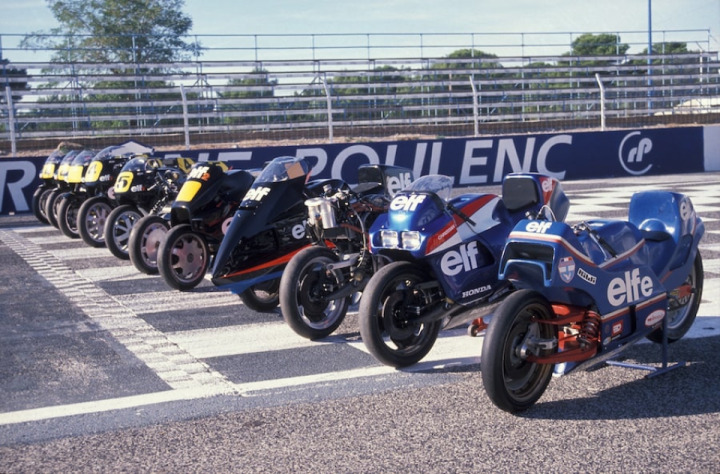
The ELF5 was the culmination of the design philosophies begun in the ELF X, offering “unparalleled braking stability… you could brake harder and later than on any conventional machine” and “exceptional chassis adjustability” (Cathcart). However, 1988 and the ELF5 marked the final run of Elf’s experimental bike project. Guiter was ready to retire and the ELF5, while still a solid performer, failed to make any significant impact on the Grand Prix proceedings. Ron Haslam continued to race it, though he failed to attain significant success. Two-time Australian superbike champion Malcolm Campbell would also ride for Elf-Honda in 1988 before going on to win his two superbike Championships for Honda.
 
Yes dear nurse will be along soon
It was a failure
The ELF5 was the culmination of the design philosophies begun in the ELF X, offering “unparalleled braking stability… you could brake harder and later than on any conventional machine” and “exceptional chassis adjustability” (Cathcart). However, 1988 and the ELF5 marked the final run of Elf’s experimental bike project. Guiter was ready to retire and the ELF5, while still a solid performer, failed to make any significant impact on the Grand Prix proceedings. Ron Haslam continued to race it, though he failed to attain significant success. Two-time Australian superbike champion Malcolm Campbell would also ride for Elf-Honda in 1988 before going on to win his two superbike Championships for Honda.
Many top 10 finishes with no development is really quite impossible to believe in the first year in top class racing I guess - if they had adopted Bimota's more advance system they would be lapping every bike on the grid after half a lap 🥳 🥳 🥳
:)(y)
 
Many top 10 finishes with no development is really quite impossible to believe in the first year in top class racing I guess - if they had adopted Bimota's more advance system they would be lapping every bike on the grid after half a lap 🥳 🥳 🥳
:)(y)
Lapping every bike after half a lap? Crickey!! Must be a big conspiracy as to why bimota didnt conquer the world. Surely teams must have been clambering to buy thier tech...
 
Lapping every bike after half a lap? Crickey!! Must be a big conspiracy as to why bimota didnt conquer the world. Surely teams must have been clambering to buy thier tech...
Shhh, you silly fekker.......... he wouldn't have realised and would have left the discussion....... 👀
 
Jean-Philippe Ruggia.

Born October 1965, his cornering style delighted fans (elbows would almost touch down in corners).

In 1989, joined the Sonauto Team, becoming their regular YZR250 rider and ranking 7th. The following year stepped up to the 500cc class.

For two years until 1991, rode the YZR500.

His highest achievement in the GP500 was a ranking of 2nd in the 1990 Belgian GP.

Debuted in the GP after ranking 2nd in the 1986 European Championship in the 250cc class. In 1987 and 1988 rode the TZ250, and in 1989 switched to the YZR250.

After riding in the 500cc class with Yamaha, returned to the GP250 and took three wins with Aprilia.


1779377283299.webp


1779377384394.webp
 
Kenny Irons

Kenny Irons was killed on warm up lap of the British F1 race at Cadwell Park on 26 June 1988. Irons was just twenty-seven-years old.

The accident happened when the bike of fellow British rider Keith Heuwen developed a misfire and slowed exiting Charlies onto Park Straight. Irons' bike hit the back of Heuwen's with Kenny being thrown off and tumbling down the side of track into the bottom of the dip on the straight.

Irons' machine slid up the track out of harms way, but a following rider dropped his machine as bunching riders tried to slow, this riders machine then slid into Kenny Irons at quite some speed so causing him fateful injuries.

Keith Heuwen and the other rider escaped injury.

It is believed Kenny Irons was still alive when taken to hospital (possibly Louth Hospital - but that is not confirmed), other sources state he died at the scene.

1780354968798.webp


1780354954198.webp


1780355343210.webp


Kenny’s first race was in 1978, and he won the 1982 250cc British Championship (Yamaha), the 1984 Yamaha Pro/Am Championship (Yamaha), and the 1986 Superstock British Championship (Yamaha).

Kenny’s first Grand Prix was on a 250cc Yamaha in 1985. He scored points in his second 500cc GP of 1986, with eighth at Silverstone for Loctite Yamaha (but I think it was actually a Suzuki).

Then in 1987 he raced for Heron Suzuki GB Ltd in 500s - the official Suzuki team in Grands Prix - with occasional team-mate Kevin Schwantz (the World Champion in 1993). That year his best result was sixth in France, and he finished 14th overall even with the team pulling out before the last three races.
 
Back
Top Bottom