Dazed and confused in La Sarthe...

millemille

Well-known member
Back in 2011 I got roped back into the bike racing paddock at the 24 hour World Endurance race. It was an experience, and then some, and I was talking to a mate about it a few days ago and he said I should write the story...

..so here it is, in a few parts.

Dazed and confused in la Sarthe...

..the trials and tribulations of an Englishman going World Endurance Racing, Le 24hr du Le Mans au 2011

On a grey overcast Monday in the September of 9 years ago found myself arriving at the back gates of the paddock of the Bugatti Circuit in Le Mans to work, supposedly, as a data logging technician for a Superstock team racing in the World Endurance Championship in the world famous 24 hour motorbike race.

How did I get here?

In a camper van...

Ok, but really.

From the mid 90's to early 2000's I raced bikes, predominantly Ducati's, with little success in a variety of classes in the UK and Europe. Due to increasing damage to body and bank balance and not a little pressure from my day job employer to give it up, or at least stop crashing, I hung up my race numbers in 2002.

Over the years of racing I'd built a relationship with one of the UK's top Ducati tuners; starting with just buying parts from him and then using his dyno for my own engines and finally helping refresh engines for the BSB team he supported.

I'd had the opportunity on a couple of occasions to spend time in the garage of the BSB team that I'd done engines for and, partly because my day job as an engineering consultant in the rail industry involved data logging, I got interested and involved in race bike data logging and analysis.

I then spent 3 seasons working, as a second job, as one of several product support technicians for the UK distributor of ECU's, dashes, data loggers, sensors and wiring harnesses which were widely used in the BSB and WSB paddock.

While the job was spread all over the paddock, the reality was that teams at the front end of the grid had their own full time data guys within the team and our involvement was limited to the very occasional failed component replacement. Down the back of the grid, however, was a different matter.

Invariably the smaller teams had either bought previously successful bikes fitted with our kit or had built their own bikes using our kit but had way over-specced the electronics, on the basis that if the winning bikes used it then so must they, but in both scenarios they'd made the purchases without recognising that you need to invest a lot of time and money in employing competent people to extract the data, analyse it, understand the changes to be made and implement them.

So my role, along with the other product support technicians, for these lower teams became much more than simply supporting the kit and moved into data analysis, recommending changes – both to bike setup and how the riders were riding the machines – and, in some cases, actually implementing the changes. Interesting, and on occasion eye opening, times.

The work at the track, both at race meetings and testing, was involving and very hard work but the reality of working with these lower end teams – who were paying the bills for our time – meant that budgets were tight.

Multi leg flights, staging through and landing at airports you'd never heard off, flying on budget airlines with woeful safety records. Hotels hours away from the race circuit in dodgy industrial estates with numerous resident prostitutes. Hours travelling in the back of vans sitting on flight cases or pile of kit bags. No time for sight seeing, no time for team meals, nothing but working or travelling.

But the money was reasonable and I didn't have to put my hand in my pocket from when I arrived at the airport until I left.

In 2006 I spent 36 weekends away from home supporting BSB & WSB and enough was enough, divorce was coming a knocking if I didn't acknowledge my marriage, so I called it a day.

Fast forward to the summer of 2011 and an internet motorbike forum where one of the members, who was part of a previously successful UK based World Endurance Team and was now part of the #44 No Limits Motor Team racing a GSXR in the Superstock class of the World Endurance Championship, is looking for people with racing experience to help the team out at Le Mans.
 
I've never had any direct involvement with Endurance Racing but, I'm sure like many, I've watched races like the Bol and Suzuka and, of course, Le Mans and I've been interested, as I'm sure have many of you, in the differences between a superbike and endurance machine. Things like the quick change wheels and how it's done, how they are crash proofed, how do they last 24hrs of track time and so on.

But I wasn't interested and didn't bother posting on the thread, but then the guy in question messaged me directly asking me if I'd come as the team were, in his words, floundering with data acquisition and analysis. I couldn't see any team of any repute allowing a complete stranger to be parachuted into their team and start looking at their data and said so.

But he was adamant they needed me and, given the guy knew my background and experience, I was sure he'd know the score with regards to payment and expenses so, with the blessing of my wife, I agreed to go.

Given I'd committed to this I thought I'd better learn as much as possible about world level endurance racing and contacted everyone I could think of who knew anything about racing a motorbike for 24hr and particularly at Le Mans.

What I learnt was diverse, interesting and challenged several assumptions I'd made.

First of all, the idea that Endurance riders are riding at anything less 100% effort and holding anything back is long gone.

The schedule at Le Mans is daylight practise sessions Wednesday, day and night practise Thursday, Qualifying day and night Friday, Warm up Saturday morning and race Saturday and Sunday.

Each team has four riders, identified by colour and with corresponding colour coded arm bands which also contain their own personal timing transponder. Three riders will race and one is a reserve in case of injury or a rider being dog slow during qualifying.

Riders have to be ready to go thirty minutes before the planned pit stop and rider change and have to stay in the pits, fully kitted and ready to ride, for thirty minutes after their session to get back on the bike in the event of a crash.

No one racing in the Le Mans 24hr is allowed to ride on the track for several weeks before the race until the practice sessions start, but being France, the land of erratic and byzantine rule enforcement, there is a“Track day” on the Monday before the race, but it's the fastest track day you'll have ever seen and every single bike out on circuit appears, in some bizarre unexplainable coincidence, to look very much like an endurance racing machine.

Bikes are set up as a compromise between all riders, although if – like our team – you've got one rider who's markedly faster than the others, no matter what you try in practise for the others, then bike set up is biased towards the fastest rider.

It soon became apparent that the racing is won or lost in the pits. The team that spends the shortest duration, over the 24hrs, in the pits will win.

The hugely successful French Suzuki team, SERT, who happen to be based a stone's throw from the ciruit, are the masters of keeping the time not spent thrashing the arse out of their bike on the track down to a minimum. This may be helped at Le Mans by them having the garage closest to the pit lane entrance, but their team principal, Domonique Meliand, has a fearsome reputation and it's possible the riders simply bend the laws of physics at his behest.

Strategy is driven by a balance between fuel consumption, tyre life and rider endurance. If you can't make your 24 litres of fuel last for an hour then you will be nowhere but there's no point looking for much beyond 75 minutes as the rear tyre will be shot and the rider on their chinstrap.

Rear tyres last one stint, fronts can just about go two stints, front brake pads – as part of the complete front caliper – get swapped at 12 hrs. Chains are lubricated and tensioned every other stop. The engine oil filler caps are replaced with an aeroquip style fitting which allows the oil to be topped up, using a pressurised container, throughout the race.

No limits have got their GSXR working well on fuel consumption and they can get about 70 minutes out of their tank of the Elf ethanol rich fuel that the teams have to buy – at an eye watering number of euro's per liter - from the circuit, more of which later.

Each team can have two bikes per entry, an “R” and a “T” bike identified on the number boards, which both go through scrutineering before putting a wheel on the track. Once qualifying has been completed the team has to decide which bike is going to be raced and then inform the stewards. The frame and crankcases have official marks put on them as they are the only parts of the bike which are not allowed to be changed during the race. The spare bike is warmed up and in the pit lane for the start so that in the event of a first lap crash and restart the bikes can be swapped and the team carry on. Once the first lap has been completed the smaller teams, like ours, quickly strip the bike down into sub-assemblies – front end, back end, tank, air box/throttle bodies and so on – which are laid out in the garage ready for crash repair duties. Larger teams have numerous sub-assemblies in their parts inventory so the spare bike gets wheeled out to the race truck and packed away.
 
The pit stops, for the top teams at least, are amazing to watch. Carefully choreographed, they are a syncopated ballet of mechanical dexterity, working within the prescriptive rules of the pit lane.

Each team has four “mechanicians”, identifiable by their arm bands, who are the only people allowed to lay hands on the bike outside of the garage. These are the guys who remove and fit the wheels and axles and carry out caliper swaps and other planned maintenance.

Then there's the two catchers who, as their names imply, catch the wheels that the mechanicians have ripped out of the bike, and literally thrown behind them without looking what's where, before they go bouncing off down the pit lane.

You've got the stop board/release man who's responsibility it is to ensure the bike stops on the marks on the pit lane floor, which the team put down during practise to align where the stands, tools and parts are laid out ready, and ensures that the bike is released safely once the pit stop is complete. This is critical as the pit lane is heaving with bikes, other team members, fire marshalls, security guards, stewards, press and associated hangers on and an unsafe release can see a bike skittling bodies and kit everywhere.

At most other rounds of the World Endurance Championship the fuelling is done using a dump can, weilded by the largest member of the team. Holding 24 or more litres of fuel, it's not light but once it's lifted up in the air above the fillers on the tank and dropped it's weight works in your favour and the fuel flows very quickly.

But not at Le Mans, oh no. Here there's a fuel header tank, fed from the circuit's fuel distribution system through a meter and holding about 50 liters of fuel, mounted about 8 foot up in the air on the wall in the mouth of the garage and full of the circuit's own fuel. On the bottom of the header is sprung loaded “Dead man's handle” valve that has to be pulled and held open to allow the fuel to flow and is operated by the “valve man”. The idea being that in the event of a massive fuel leak from the rig the flow can be stopped instantly by the valve man simply letting go of the handle.

From the valve runs two lengths, about five meters long, of 4” flexible hose; one to carry fuel to the bike's tank and the other to carry the air, expelled from the tank as the fuel goes in, and the fuel overflown as the bike's tank is brimmed, back to the header. Some teams – the ones with deep pockets - use the fancy Staubli tank connector which uses a very clever double wall single, larger diameter, hose.

On the end of the hoses is a quick fill nozzle assembly, type depending on the fillers on the bike tank, with handles that are weilded by the fueller.

The fueller can only touch the bike when no-one else is, so the wheel changes and any other maintenance has to be complete before the fuelling can start.

The third person required for fuelling is the “Fire man”; equipped with a fire extinguisher their responsibility is to stand ready at the shoulder of the fueller to heroically save the day in the event of a fuel spill catching fire.

All three people involved in fuelling have to wear fire proof overalls, gloves, balaclava hoods and googles so look incredibly macho and in no way like a music hall comedy act if the kit doesn't match or fit.

And then you've got one person overseeing all of this, making sure the right people are doing the right thing at the right time and keeping all of the hundreds of bodies milling about out of the way.

By my reckoning that's eleven people before you start adding in the people looking at the bike without touching it, while others are working, to check for leaks and damage and missing fasteners and the like....
 
A couple of weeks before the race I get back in touch with your man, let's call him “Mark”, on the forum to sort out travel and accommodation.

“Do I need to book my own flights and hotel or is the team doing it?” I ask “Mark”.

“No need” says he “I'm driving the “The” Motor Home down and we'll travel and sleep in that as it gets parked up in the paddock”.

The emphasis he places on “The”, and knowing the size of the motor homes in the race paddocks I've worked in, that sounds reasonable. So we agree to meet at Nell's Cafe, just down the road from Brands Hatch and my home, by the M20 and on “Mark's” drive down to Dover. Friday afternoon, for a Friday night sailing on the freight ferry over to Dunkerque.

Come the allotted hour I'm at Nells, waiting expectantly for a substantial, Winnebago style, motor home to pull up in the car park.

“Mike?” a voice asks. “I'm “Mark”...”

I follow him out to the car park, wondering where he's got “The” motor home parked up.

“What the fuck?”. He opens the door on a shitty, mildewed, tired, old, “dormobile” type of camper van. Now, what I should have done at this point was say “No thanks mate, not interested” and gone home.

Instead, I grabbed my kit bag and kissed my wife good bye, with a cheery “see you in 10 days”, and got in....
 
We trundle, at a steady 50mph, down the M20 to Dover. No problem, I think, he's taking it steady because he's early for the ferry and doesn't want to spend ages sitting in a grotty lorry park at the docks.

Nope, he drives everywhere – for the full 800 mile round trip – at this painful speed.

But wait, I hear you say, it's only a 700 mile round trip from Nell's to the Bugatti circuit! Well, while we're eating dinner on the ferry, which we'd bought for ourselves but I'd kept the receipt in the expectation of submitting to the team for expenses payment, “Mark” tells me that we're making a diversion on our journey and we're going via Paris, Charles de Gaulle airport to be exact, to pick up another person who'll be working for the team.

Turns out it's another forum member, an Australian who goes by the username “Suspensionsmith”. This guy is flying half way round the world to meet a total stranger and be driven into deepest, darkest France to work for a team of Italians racing motorbikes for 24hrs.

Fair fucks to the feller...

Actually, this is great news. Suspensionsmith is a kindred spirit, an inveterate tinkerer with bikes who's fond of jamming oversized engines into frames that were never intended for such monstrous power – FZR400 with a Blackbird lump sound mental enough? - or making stupid off road machines – a ZX10R 'crosser anyone? - and he's also a funny front end devotee, which is fortuitous as both my Bachelor's thesis and Masters dissertation were funny front end related, one bicycle and the other motorbike.

Anyway, we get off the ferry in the early hours of Saturday morning and start driving, slowly, toward the bright lights of Paris.
 
We've been on the autoroutes for about 3 hours and haven't reached even the outskirts of Paris, being overtaken by EVERY other vehicle on the road, when “Mark” pulls up over at an “aire de repos”. If you've not driven on French autoroutes before an “aire de repos” is a car park by the side of the motorway with no facilities other than a set of, normally disgusting, pissoir toilets. No shops, no petrol station, nothing but trees, overflowing bins and shit spackled holes in the floor...

“Grab your sleeping bag” say “Mark” “we're stopping here as I'm too tired to drive any more”.

“Hang on” says I “One, what sleeping bag and, two, why don't I take a turn at driving?”.

“Oh” says Mark “Did I not tell you you'd need a sleeping bag?”.

“Very definitely not” I reply “And do you know how I know that you didn't? Because I wouldn't fucking be here if you had. MIKE DOESN'T SLEEP IN A SLEEPING BAG! You asked me to come, the least I expect is a hotel room or decent motor home with beds and duvets, not my own sleeping bag in this turd of camper van”.

We retreat, in silence, to opposite ends of the van, “Mark” into his sleeping bag in the bed over the cab and me, wearing pretty much all the clothes I'd packed in an attempt to keep warm, on one of the narrow, rock hard side benches.

Turns out “Suspensionsmith's” plane doesn't land until lunchtime, so there's no need for us to to take turns driving. I'm baffled as to why we had to get the ferry on Friday night, any normal person would have left early Saturday morning and driven, at the speed limit, straight from the port to Paris in a matter of a few hours.

After a few fitful hours sleep, on my part at least, we're on the move – slowly – again. We stop at proper service station for breakfast, again I keep the receipt to claim it back from the team on expenses, and then slog our way round the Periphique to the airport to pick up “Suspensionsmith”.
 
Picking our way through the notorious Paris rush hour traffic, which in reality is pretty much 24/7, we get to the arrivals part of the terminal. “Mark” hops out of the driving seat, opens the door to get out and tells me to take over driving and just keep circling until he comes back with “Suspensionsmith”. “Why not just park in the short term car park and claim the parking charge back from the team on expenses?” I ask. “Mark” just shuts the door and heads off to find our Aussie charge.

90 minutes of “just circling” later, convinced any minute I'm going to be leapt on, with extreme prejudice, by the CRS due to the extremely suspicious behaviour of a foreign registered vehicle at an international airport “Mark” hoves into view with “Suspensionsmith” in tow.

Quick introductions made and “Mark” is back in the driving seat and we're now heading for Le Mans.

“Hang on” I say “Where's your luggage “Suspensionsmith”? He's only toting a small rucksack.

“Air France has lost it, mate”

“Oh shit. Well, I've got loads of spare clothes you can use until we can get to a hypermarket and get you some more and a sleeping bag...”

“Sleeping bag?”

“Yes mate, I'll explain later...”

“Nah, she'll be right” Yes, he's Australian and he genuinely said that. “I've given the airline the address of the circuit and they've said they'll send it to the track as soon as they find it”.

“Mate, they've just told you that to get rid of you. You're never going to see your luggage again!”

“Nah, she'll be right. That's my luggage for the rest of my trip so they'll find it and get it to me..”

It turns out the rest of his trip is to the West coast of the states to see the giant redwood trees. Why, you may ask? Because it turns out that before “Suspensionsmith” made a living fettling suspension and building bonkers motorbikes he was a tree surgeon, and not just any tree surgeon but the official tree surgeon for the Australian Prime Minister's residence in Canberra.

I. Have. No. Words

“Suspensionsmith” gets his down for a nap to try and recover from his jet lag as we trundle south west, passing fields full of big arse Charolais cows.
 
We pull off the autoroute a good hour away from Le Mans and spend an interminable time driving around looking for the cheapest fuel in several small towns until “Mark” is satisfied he can't find any cheaper, and then puts barely enough into the tank to, in my opinion, get us to Le Mans. Odd, as all he needs to do is fill up and keep the receipt and claim it back from the team on expenses.

“Mark” takes the opportunity, once we've arrived, to drive us round the public road sections of the full “La Sarthe” circuit used for the 4 wheeled 24 hr race. Fuck me! The Mulsanne straight is very, very long. Even more so at 50mph in a camper van.

What I find a little strange is that, despite Le Mans and the Bol D'or being such massive events that attract tens of thousands of mentalist spectators on all kinds of bikes, there's little or no evidence to be seen of the race being less than a week away.

We head into town and find a Carrefour and me and “Suspensmith” head in to get food and sleeping bags.

The camper van is parked up in a layby and after some exotic French hypermarket nosebag I climb into my new sleeping bag, which is made from the most nylony nylon in the history of nylon so, while I'm not particularly hot, I'm sweating buckets within seconds and building up a static charge that is going to remove eyebrows when it discharges like something from Dr. Frankenstein's laboratory.
 
Monday morning dawns dull and overcast as we're woken by the rumble of trucks pulling out of the layby. Let's recap...

It's taken 2 ½ days to make the journey from Brands Hatch to Le Mans, a journey that would normally take 8 hours. All the way down “Mark”, who is a really genuinely nice guy, has been telling me tales of his derring do and racing expertise and, while he obviously knows his stuff, it's getting a bit “during the war...” so I'm looking forward to getting to the circuit and getting the lie of the land and meeting the team and putting my expenses claim in.

After a couple of slightly stale croissants, courtesy of yesterday's Carrefour visit, for breakfast we head off to the circuit. We're driving through the fields surrounding the circuit and everywhere you look there are massive, like 30 foot high, towering piles of wooden pallets surrounded by harris fencing. I ask “Mark” what they're for and he smiles and says “You'll see”.

We get to the paddock entrance and have to wait outside the gate for over an hour, watching a steady stream of every kind of vehicle from big name team artics to camper vans even scabbier than ours get in, as the team have not left the promised passes at gate. “Mark” makes many phone calls and eventually someone pedals down to the gate with some passes and we're in and get parked up in the nearly full paddock car park.

The “track day” is in full swing by the time we've got down the garage so introductions can wait, “Mark” and the the Italian crew chief gives us a quick tour of the bikes...

There's two GSXR1000R's, painted in very yellow with their red number boards, sitting on paddock stands.

Immediately noticeable are the huge, bulbous, tall fuel tanks. Endurance racing technical regulations allow the tank capacity to be increased to 24 litres and most Superstock teams do this by welding a box shaped extension to rear of the tank that sits under the rider and inside the subframe However these guys have effectively cut the standard tanks in half horizontally and then welded in a spacer and put the top half back on top to make the whole tank taller, a lot taller, in order to get the extra capacity.

I'm not sure why they've bucked the trend and done this, I suspect it has something to do with listening to “Mark” but it appears they are now regretting it.

Because all the extra fuel is higher up it is, unsurprisingly, causing them handling and set up issues as there's a very pronounced weight transfer under braking and acceleration, plus a reluctance to lean, when the tank is full.

If they dial that out when the tank is full the bike is nigh-on unrideable when the tank is less than half full.

The tanks have got double quick fillers, which are cheap ATL knock offs by the looks of things.

The obligatory gold Swedish shock absorbers sit in the back and up front they've got Andreanni fork cartridges, which are very trick. They make the fork legs longer and allow ride height to be adjusted without altering preload or moving fork legs in yokes.

The seat sub frames are heavily reinforced and seat unit has push contacts, like you'd find on the tailgate of a car, for the built in rear lights so there's no separate connectors to fiddle with if you need to remove the seat unit in a hurry.

At the front end the mudguards are rubber mounted so that the fork legs can be rotated to allow the wheel to be changed without removing the calipers and the front mudguard mounts are spaced further out to allow the front wheels to be changed without the brake discs snagging on the mudguard and slowing changes. I'm a bit surprised to see this as I was sure, having had a quick look before I set off, that the Superstock technical regulations stated that the front mudguard must be attached to the standard mountings and the inside width must be the same as the homologated road bike.

All the brake calipers are fitted with dry breaks, heavily chamfered brake pads to lead the disks in and magnets in the pistons to pull the pads back to the pistons; all to aid with rapid wheel or caliper changes.

There's a huge fluid reservoir for the front brake master cylinder, about double the normal size, to prevent the fluid from overheating and they've got aftermarket Brembo radial master cylinders fitted.

Each clip on has loads of switches fitted, they're using repurposed standard switch clusters, for main ignition on and off, start and kill, pit lane speed limiter and turning on and off the two separate lighting circuits. The separate lighting circuits are not, as I'd expected, front and rear but left and right; the idea being that a crash ripping off a clip on would lose half of the bike's front and rear lights, leaving it in a safe state to be limped back to the pits in the dark.

There are two HID lights, mounted one on top of each other, attached to the inside of the front fairing, behind the class identifying yellow lens cover. I'm told one's a flood and one's a spot, with the spot aimed lower than the flood. The idea being that the spot, with it's longer but tighter beam pattern illuminates the track further in front of the bike when accelerating and at high speed and the flood is when the bike is braking – so the front of the bike is nose down – and turning in or during the corner and the peripherals of the track are lit.

They're running Pirelli tyres, slicks not road tyres.

There's a noticeable lack of crash protection fitted, only the FIM mandated engine cover protectors from GB Racing. It's explained that you need to protect the frame and crank cases, as they're the only parts that can't be changed during a race, and that most crash bungs risk damaging these if they dig in. So the idea is that you want the bike to slide and shed energy by trashing the bars and pegs and fairings and the like and then get the bike back to the pits and replace these consumable parts.

Each bike's got a standalone AIM data logger fitted, but there's very few channels actually being logged. What they're logging is about what your average club racer would be looking at and nowhere near what I'd expect for a bike being raced in a world series. Already I'm wondering what value I'm going to be able to add here.

I'm told the team had a decent result earlier in the season, they'd podiumed at the 8hr race in Albacete, and as a result they'd attracted some attention and had been given some fancy new parts for Le Mans by Arrow; exhaust system and rearsets looking particularly sprauncy as they sit in their boxes waiting to be fitted.
 
The years have not been kind to my memory and I can't remember the rider's names. They were all identikit, journey men, European racers. In their twenties, taking a ride wherever they can, paying for the privilege in the hope a team can give them a decent bike that they can make their name and reputation on, battered leathers covered in personal sponsors labels from small European companies you'd never heard of.

The team manager is shaven headed, middle aged man by the name of Mareno. He arrives at Le Mans several days after the rest of the team and it is fair to say that his management style is, at best, erratic. He vacillates between obsessive micro management and complete indifference.

Image


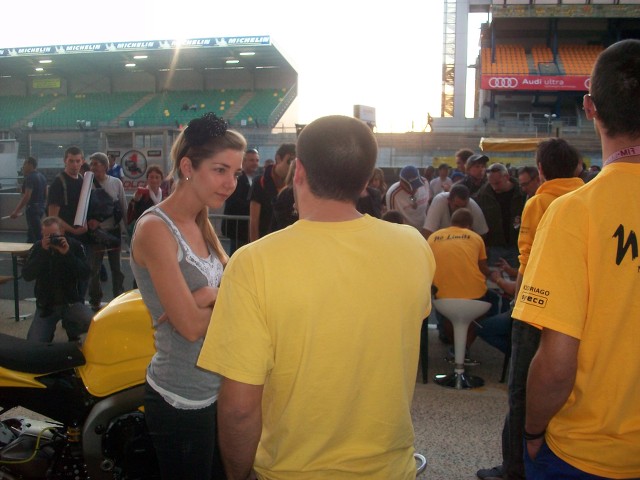
This picture was taken on the Friday afternoon, after qualifying had finished. The riders haven't got any faster despite having had hours and hours of track time over the last week and there's only fifteen minutes of warm up track time left before the race itself. The pit lane is about to open so that tens of thousands of rabid endurance racing fans can come and meet their hero's.

The team are talking about changing spring rates; a sure sign of a team lacking in direction and clutching at straws, to be considering something so fundamentally different that should have been put to bed on the first day. “Suspensionsmith” is talking with the crew chief, trying to steer him away from this move.

And our glorious leader?

He's rocked up in his flip flops and white towelling dressing gown as he's heading off for a shower.

Must be an Italian thing....
 
“Inch” is the team's data guy and also, from what we're told, the team tactician who'll be calling the shots on pit stops from the pit wall. He's young, obviously bright, strikes me as being a professional engineer and a fairly recent graduate but he's not interested in me despite when I'm introduced “Mark” and the crew chief are at pains to explain what I used to do and what teams I've worked with. It's obvious there's no way he's going to let me near the data or have any input.

Our Crew Chief is in his early 30's and strikes me as a good solid and competent guy, exactly what you need in a crew chief. He's open and welcoming and appears glad we're there, although I get the feeling that there's a bit of needle between him and “Inch” and I can see him get visibly frustrated with “Mark” a few times when he launches into yet another “During the war...” story.

He looks like a stereotypical italian, dark and swarthy and needs to shave again before he's even finished shaving.

There's a couple of young Italian, identikit, mechanics; young, cocky, trendy specs, doesn't know anywhere near as much as they thinks they do.

We've got a Chef. A big young feller, permanently cheerful and a real trooper, banging out huge portions of good food for everyone.

“Bob” is the tyre man. The team will get through somewhere a lot, somewhere around fifty, tyres over the course of the week, and each wheel needs to be taken to the Pirelli compound in the paddock so they can fit the tyres and then bring them back to the garage, put the wheel in warmers and keep track of all the wheels and tyres for the crew chief.

Bob's Belgian and he rides around the paddock on a sit up and beg bicycle with a set of bars welded across the front and back of the frame on which he hangs wheels and tyres.

And he drives a huge old Mercedes van. The van is going to be leaving the circuit in a week's time, rammed to gunwales with used tyres that he's rescued from the bins behind each team's garage, and which form the basis of his track day tyre business back in Belgium.

He's a lovely bloke, slightly eccentric but charming and funny company in the evening around the dinner table.
 
There's some wobbly advertising boards on stands up in the garage, lining the walls and creating back wall, behind which all kinds of secret squirrel stuff can happen, and little cabin set up on the pit wall with a pit board, illuminated for night duties, that slides on runners out onto the track.

One noticeable absence is a lighting rig. Pretty much every other garage has some form of frame projecting out from their garage over the pit lane with halogen lights hanging off it to illuminate the pit stop area at night. We're told it's not needed as there's so much other light sources in the pit lane at night.

They've got a compound set up in the paddock, three Italian vans and the camper van parked in a square with a marquee set up in the middle. There's a couple of long tables and benches in the marquee along with Chef's oven, a big arse fridge and freezer.

Everyone sits down together every evening for Chef's dinner. Huge bowls of pasta, which the riders have plain with a touch of oil and cheese while the rest of us have it smothered in tomato sauce, some form of grilled meats and lots and lots of slalad. Proper Italian fare.

Rotgut vino or beers and the strongest coffee, the kind of stuff that strips chrome, to round it all off.

One thing I'm wondering, as everyone is sitting around the tables after dinner, is where's everyone else? We're short quite a few bodies, based on what I'd been led to expect was the minimum to carry out pitstops.

I speak a reasonable amount of normal conversation French, along with some technical Italian, and it's enough to be able to listen in to the Italians talking and I'm getting the strong impression that they think I'm to be the fueller.

Tuesday dawns overcast and stays that way all day.

The plan for the day is getting the bikes through scrutineering and plenty of relaxing, resting and sleeping. The old army ethos, Drink when you can, eat when you can, sleep when you can very much applies as we'll be on the go for more than 30 hours non-stop over the weekend.

“Suspensionsmith” and I go for wander up and down the pit lane an around the paddock for a look see as the Italians aren't proposing to do anything with the bikes until lunchtime.

It appears that garage allocation is decided using an algorithm that considers, firstly, how French you are and, secondly, how good at endurance racing you are. The more French and faster you are, the closer to the pit lane entrance you are.

There's a real contrast with the WSB paddock I'm more used to, while both are world championships and the top teams professionalism and set ups are the same once you've got a little way down the pit lane it's like club racing and the further you get down the pit lane the more amateur you get. There's garage's down the far end with bare walls, a couple of deck chairs and crate of beers to bribe anyone passing to help with a pitstop.

While I've never been in the WEC paddock before now there's still a few familiar faces, like Mark Hannah from BSB days (I knew him when he was at Crescent Suzuki and was Shakey Byrne's crew chief) in the Honda TT Legends Endurance team, being overseen by Endurance Racing legend Russell Benney, so I get a fair few chances over the course of the week to speak to guys in a proper endurance team and see the difference between the top of the WEC field and our lowly spot way back down the pit lane.

A lot of the Honda TT Legends crew were in the same, previously world championship winning, team as "Mark" and, slightly worryingly, every time “Mark” is mentioned there's much eye rolling and knowing glances exchanged between them,

Le Mans is one of the few rounds in the WEC where there's an Open class for heavily modified homologated machines or pure prototypes. The only obvious Open class machine is the Metisse, a GSXR1000R powered funny front end effort.

Image


Image


Bolliger Kawasaki are an interesting bunch. A Swiss privateer Kawasaki outfit who run in the top 10 normally, they have a liking for dungarees and luxuriant moustaches – even the women – and, in marked contrast to my team of voluble Italians, work in complete silence. They had a gearbox failure on their ZX10R early on in the race and they dropped the engine, split the crankcases, swapped the gearbox internals and put it all back together in about an hour without, from all accounts, a single word being exchanged between any of them.

Image


Monster Energy Yamaha, who are long term endurance racing front runners Yamaha Austria Racing Team (YART) with a different sponsor, are practising their pit stops and it is an absolute joy to behold. I don't know why, they're not doing anything that other teams aren't but it just looks so smooth and controlled and tight.

There's a rumour that Guy Martin is here, racing under an alias, for a French Suzuki Superstock team. Given that he turned up at Le Mans officially for the same French Suzuki Superstock team a couple of years later it may have been true, who knows? Other than Guy, obvs. And the French team. And the organisers. But apart from them, who knows?

Suspensionsmith goes for a ride around the circuit on Bob's bike in the twilight on Tuesday and returns in the pitch dark blowing out of his arse, it's a long old circuit....
 
Late Tuesday morning the bikes are shown a bit of TLC, a polish with Mr. Sheen to get yesterday's dead flies and rubber detritus off, and then wheeled out of the garage and up the paddock to the scrutineering bay where we join the queue of the best part of a hundred bikes, all waiting the yay or nay from the officials.

In a completely unpredictable turn of events, no really, the scrutineers are less than happy with our front mudguard mounting. I say “less than happy”, they initially thought we were taking the piss out of them and got quite angry and then when they realised we weren't taking the piss out of them they started laughing, and called over every other official in the building to show them what we'd done, all of whom joined in the laughter before we were sent away with a flea in our ear.

The bikes were wheeled back down to the garage and the search for a non piss taking, but quick wheel change allowing, solution began.

The regulations state that the front mudguard internal width must be the same as that on the homologated model, but we don't know what that is. But do the scrutineers? We think not.

So we can make the width as wide as we can without it looking ridiculous, and the reality is that the scrutineers will be looking for it to be narrower than it was.

The 10mm rubber spacers that currently sit between the mudguard and fork legs are cut in half and we try a front wheel change. There's some alarming creaking noises from the fibreglass mudguard as the fork legs are rotated in and out to get the calipers clearing the rim and you have to be fairly forthright in dragging the front wheel out and jamming it back in as the disc bobbins just catch on the inside edge of the mudguard.

But it's doable. The mudguard still looks, to the experienced eye, to be wider than stock so, in an inspired moment of genius or madness – depending on how the scrutineers view it, a doubled over strip of speed tape, colour matching the mudguard, is stuck on the inside edge of each side of the mudguard to give the visual impression of it being narrower.

The bikes are pushed back up the hill to the scrutineers and, in calculated act of civil disobedience designed to put pressure on the scrutineers to get rid of us, we blatantly queue jump our way to the front, attracting a cacophony of shouts and booing from those patiently waiting in the queue, and with everyone “accidentally” milling around in front of the bikes in an unfortunate coincidence which regrettably restricted the scrutineers view of the bikes, we pass scrutineering.

Giggling like naughty schoolboys we leave before anyone wises up.

Wednesday and Thursday and shit's getting real with official practise.

It's the first time the pit lane has been fully staffed with all of the stewards, marshals, fire marshals, security guards, press as well as all of the team members and it's ridiculous just how busy it is, they can't seriously be expecting a bike race to run through this heaving scrum can they? The need for the 60kph speed limit starts to make sense..

I have a confession to make. My name is Mike and I am a pit lane speed limiter addict. It's been 9 years and 1 month since I last succumbed. I fucking love pit lane speed limiters, the noise, the lack of mechanical sympathy, the fact they make ant race meeting sound like a Star Wars pod race....

Each team has a pink naughty card that must be kept in the garage and be available for inspection by the officials at all times and it is on this that the officials record all transgressions from the myriad and many rules. Once you've achieved a certain number, and type, of transgression you face a penalty, up to and including disqualification.

Practise is under way and there's a bike out there that's getting louder and louder as it goes past the pits every lap. It's now obnoxiously, offensively loud and the pit wall is lined with bodies, all trying to see which clown team bike is making the racket.

Yes, it's us....

The bike comes in and it's obvious the exhaust is blowing. The 2nd bike is wheeled out and the riders head back out to try and break that one...

The exhaust is blowing under the sump so, donning heat proof gloves, the exhaust system is stripped down and the collector is on the bench for all to inspect.

They're running a new Arrow system, super light weight fabricated from incredibly thin wall Inconel, which although it looks like a 4 into 2 into 2 design is actually a pair of 2 into 1 into 1 systems side by side, with the two separate systems running side by side in the collector.

The collector is fabricated from folded sheet metal and looks in profile like a single round tube but is actually, in cross section, two capital “D” arranged back-to-back.

The bottom corner of one of the “D” sections has split along the whole length of the collector. It's easy to see why it's split, given the heating and cooling/expansion and contraction that goes on in an exhaust and the tight radius bend concentrating the stresses.

The 2nd bike has the same system fitted and the team don't have any spares.

While a blowing exhaust is no problem, noise wise, as there's no noise limit for the event it is a problem for engine reliability. An exhaust leak will cause the engine to run lean and lean running means hot exhaust valves and hot exhaust valves, in a 24hr race, means valve failure and catastrophic engine damage and retirement and unhappy Italians.

An hour so 's track time later and the 2nd bike starts getting louder, so the it's pulled in and the exhaust system is also stripped and it's doing exactly the same. This, obviously, is a problem...

What to do? It's game over for today and possibly game over for the whole event. Someone has the bright idea of taking a walk down the pit lane to the SERT garage and having a word with them. They're running the same model Suzuki, but aren't in the same class as us so we aren't direct competitors, and, more importantly, SERT is based a stone's throw from the circuit and they have all kinds of clever people and equipment there.

Amazingly, SERT agree to help and the failed collectors are taken back to SERT's workshop and overnight the cracks are welded up and also have a couple of straps welded around the outside to try and prevent excessive movement of the metal.

Thursday morning we fit one and keep one back as a spare. The repair worked and lasted for the remained of the whole event. Its almost as if the multiple world champions might know what they're doing.....
 
Moreno arrives mid Thursday morning and he introduces himself and confirms, based on nothing more than my size and apparent strength, that I'm going to be the fueller. When I ask about data analysis he just shakes his head, “no”.

You have to use the Ethanol laden ELF E10 race fuel supplied by the circuit for qualifying and racing, the stewards regularly take fuel samples from bikes to check what's in the tank and teams have, and still continue to be to this day, penalised or even disqualified if they find “Fuel irregularities”.

But for practise you can use whatever fuel you want. The Italians have brought several hundred litres of Shell's finest super unleaded with them from Italy for the track day and practise sessions.

They've also already got a hundred litres or so of the circuit's ELF race fuel in a drum. Teams pay for the circuit's fuel as it goes into the garage's header tank, not as it goes into the bike, so it looks like the Italians took all of the fuel left in the header tank at the end of last year's race which they'd had to pay for, and I suspect they may have liberated fuel from several other team's header tanks, and poured it into a big drum and they've brought it back with them.

The organisers will not be impressed if they find out.

Teams are supposed to only fuel their bikes out in the pit lane, but the Italians are removing the tank from the bike and taking it out the back of the garage, away from prying eyes, to fill it from their stash of fuel.

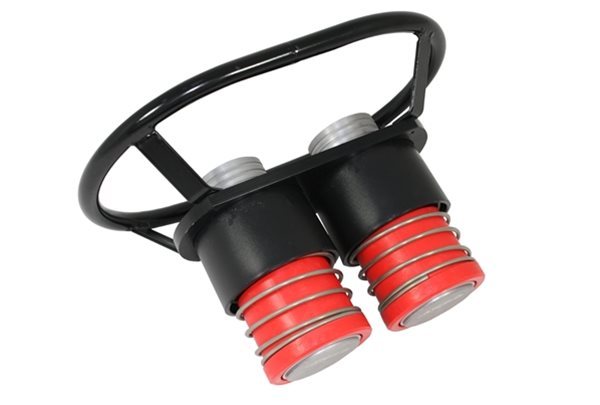
There's two elements to the fuelling systems on Endurance racing bikes, the filler caps....

Image


...and the nozzles

Image


The photo's show typical ATL components.

The filler caps on the bike's tank have sprung lids which are the centre sections of each cap assembly, moving up and down on sliders. Getting air out is as big an issue as getting fuel in, hence the two fillers; one for fuel in and one for air out.

Nozzles have a fixed metal centre section and sliding, sprung to the closed position, outer sections.

As the nozzles are pushed down into the tank the centre section pushes the cap down and is inserted into the tank and the red sprung outer section is pushed up, sliding up the centre section and exposing a series of holes in the centre section through which fuel flows down or air flows up.

As the nozzle are withdrawn the sprung outer section comes back down the centre section, covering the holes and stopping the fuel flowing, and the sprung caps spring shut, sealing the tank.

The same system is used at all tracks, but only at Le Mans are the nozzles connected to flexible hoses, on an mounting plate with handles something like the ones shown in the photo above, rather than on the bottom of a dump tin, and is referred to as “the rig”.

It takes about 6 seconds to get 20 litres of fuel into the tank.

The team's rig is dragged out of the back of one of the vans and presented to me...

Image
 
It's quite obvious the rig hasn't been touched since last year's race and is in a poor state of repair. It's using ATL knock off nozzles and they're pretty poor quality, the machines surfaces feel rough and when I push the sprung sections up they don't slide smoothly and don't spring back down.

The hoses look very short and they're held together with gaffa tape, always a good sign in a world championship...

It's an odd design, at odds with every other design I've seen as I've been nosing around the paddock. Everyone else's rig has the handles as low down as possible, smack bang on top of the bike's tank so that you can push them down, but the handles on this rig are way up in the air.

I get to work stripping down the fillers, trying to get to the bottom of why they are sticking, and it looks like poor surface finish of the machined parts combined with swollen o-rings is the culprit.

What I'm supposed to do about this I'm not sure.....

As it gets dark and the first night time practise session kicks off the speed difference between the top and bottom of the pit lane really becomes apparent. We're a few seconds off the front but there's teams who are nearly 30 seconds adrift and if you get a fast and slow bike coming out of the last corner together it's downright dangerous how quickly the fast bike overhauls the slow one, and the sometimes wild avoiding action the fast boys are having to take.

It's been my experience that in any team with two, seemingly identical, bikes the rider will prefer one over the other. There's never any discernible reason for why the preferred bike is better, and I've seen it drive crew chiefs to distraction, to the point where they try and hoodwink riders by disguising the bikes to get to the bottom of it, without success.

And it's the same here, one bike is getting far more track time than the other because all three riders prefer it.

But there's a problem, I know, who'd have thought? The preferred bike is weeping oil from the bottom of the crankcases. It looks like a bolt, or possibly the sump plug, was over-tightened by the Italians when they refreshed the engine after the last outing and it has cracked the cases.

The decision is made to carry on riding the preferred bike for qualifying, keeping a close eye on the oil, and a decision on which bike to race will be made on Friday.

It's getting towards the end of the day and two of the three riders are not getting any faster and the gap between them and the third rider is growing, he (Alessio Aldrovandi I think) is now around 2.5s per lap quicker.

As a team, our fastest lap is about two seconds off the fastest Superstock team's.

The doesn't appear to be a plan on how to bring all 3 riders up to roughly the same speed and how to get the whole lot of them faster. There's a definite lack of direction.
 
t's mid morning Thursday and one of the Honda TT Legends guys comes wandering in to our pit box. “Have you got a guy working here by the name of ******?”, and says “Suspensionsmith's” real name.

“Yes we do, why?”

“Because there's a huge kit bag just been delivered to our garage for him”

It never is! Yep, “Suspensmith's” missing luggage has only gone and bloody well turned up!

The courier that Air France had given the bag to had been to the circuit entrance, they'd sent him to race control, race control had looked at “Suspensionsmith's” name and decided it was English and then looked at the list of entrants and spotted the only British team – the Honda TT legends – and sent the courier down to their garage. The team in turn had remembered that there were a couple of British guys in the No Limits garage and had come and found us.

So “Suspensionsmith's” colonial optimism was well placed and my typical British cynicism was misplaced...

..and the gently pervasive, but rapidly worsening, smell from “Suspensionsmith's” five day old socks could be addressed.
 
I'm working in the garage with the crew chief on Thursday evening, doing a tightness and security check on the bike, and he's asked “Mark” to go off on what seems to be very much a “Bucket of steam” mission when he, unprompted, tells me that they though “Mark” would really be able to help them, having come from a championship winning team, but the reality has not met expectations and if it wasn't for the fact that “Mark” brought people with him to help the team at races he'd have been given the boot because he's all talk and when it comes down to it he can't hack it. That would explain the behaviour of his former colleagues now at Honda TT legends.

Qualifying Friday and we're over 3 seconds off the pace and there's still a big gap between riders and nothing changes throughout the day and night sessions. We end up down near halfway down the grid for tomorrow's start.

It seems we are pretty much top of the session length that anyone is running in the Superstock class, no one else is able to stay out as long as we are, so we will probably save two or even three pitstops over the competition during the 24hrs of the race.

It also seems that our creative interpretation of the technical regulations for the front mudguard is paying off as we can get the wheels changed a few seconds quicker than the other superstock teams.

There's been little or no visible data downloading and analysis, Mark was right in that respect.

Tyre wear looks good, but if I was being uncharitable I'd say that with the lap times we are doing I'd hope so.

The decision is made to race the bike without the oil leak, despite it being the less favoured bike the oil leak on the preferred bike is just too much of a gamble.

Tactics for the race are of the Fred Gassit school of racing, “Gas it, you wanker!”. There'll be a front tyre change every stop, better than safe than sorry, and we'll run 70 minutes for the fast rider and 60 minutes for the two slower riders, at least to start off with.
 
We have our first and only pit stop practise, there's not enough of us to carry out one role each, so there's lot's of doubling up of roles and shuffling around until it seems to go reasonably smoothly.

Suspension smith is front wheel “mechanician”.

I get one chance to practising dry fuelling, we've still got plenty in the fuel stash to use, so there's no fuel from the header tank flowing.

It doesn't go well. The top of tank too high, due to its sheer size and the bike being up on stands. I'm on tip toes and struggling and I'm not short.

The photo below shows the bike after the finish at Albacete and you can get an idea of the sheer size of the tank and how high the top is.

Image


The hoses are too short, they're not on the ground behind me when the rig is in position over bike, and we don't have enough people to hold the hoses up as other teams do. So I'm supporting the weight of the hoses, and when they're full of fuel it will be worse, and they're pulling the rig and the fillers towards the header tank.

The rig handles are in the wrong orientation and are too high up and I'm really, really struggling to align the nozzles accurately enough for them to engage with the cap and operate.

The nozzles are sticking, sometimes for a micro second, other times permanently when they are pulled out the tank

I strip them down again but I can't get anyone from the team to listen. “They worked fine last year..” is all they'll say to me. Which I later find out is a lie, they had the exact same problems last year
 
I corner Moreno and wave a handful of receipts at him and ask how he wants to pay my expenses. It's no language barrier that is causing his bafflement, he genuinely doesn't know what I'm talking about. “Mark” has lied by omission, not only am I not getting any expenses I'm also expected to contribute towards food. I have a frank discussion with Moreno and make it very clear that, given my previous experience and the manner in which I was asked to come, by someone who claims to be a senior member of his team, I won't be paying for anything. It his choice to not be using my ability and experience to his advantage but I'm no starry eyed fan boi, desperate to be here, and I'm quite happy to go home and leave them to it.

After daytime qualifying is over on Friday the pit lane is open for fans to meet the teams, tens of thousands of them descend on the garages. We put the bike with the oil leak in some snazzy friesian cow patterned tire warmers and stick out in front of the garage and set up a table and chairs for the riders to sit at and sign autographs.

Here's "Suspensionsmith", complete with his "Mechanician" arm band, apparently deep in thought (you can see fuel header tank on the wall)

Image


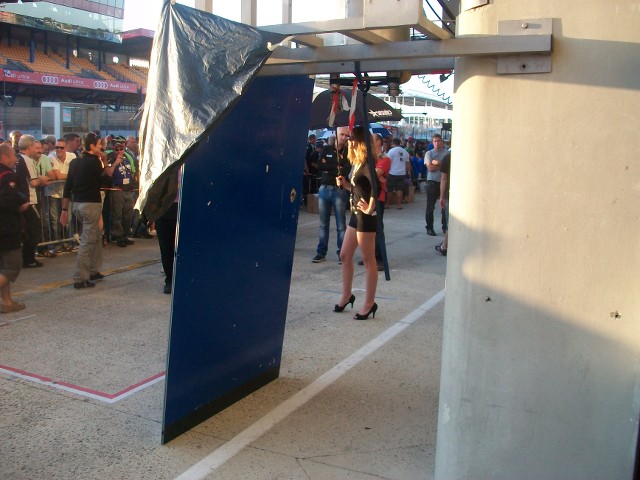
And here's the 3D Kawasaki team's brolly girl who "Suspensionsmith" is deep in thought about...

Image


Our crew chief is a hit with the ladies, lifting the velvet rope to invite pretty girls in...

Image


Pit walk over. After dinner and once night has well truly fallen on friday “Suspensionsmith” and I take the opportunity to go for a walk around one of the camp sites, with Mark Hannah and some others from the Honda TT Legends team.

It's an eye opening experience, a trip into a full on “Mad Max” post apocalyptic wasteland in the dark.

It's like a medieval army camp, there are fires and tents, of all sizes, scattered everywhere. There's all of the alcohol ever, in both quantity and kind, and everyone is in various stages of drunk, between gently amusing and wide eyed “RUN FOR YOUR LIFE!” drunk that our continental comrades do so well.

Everyone is very, very hospitable – particularly when they spot the guys from Honda TT Legends in their branded work wear – and we're offered everything from warm stubbies of cheap dubious French lager to swigs of home distilled spirits, or what could be avgas, from filthy plastic bottles that look like they previously held screenwash or anti freeze.

There's an immaculate ZX12R with a side car that looks for all the world like it came out of the Kawasaki factory, an old FJ1200 with a swingarm that ends in a different post code with a car tyre on the back and a nitrous bottle the size of an aqualung, a CX500 rat bike that looks like it's been set on fire then dropped in a lake and left for several years and then dragged out and set on fire again.

And there's all the latest race replica superbikes, tooling up and down the unpaved tracks, every now and again the rider giving it a handful of throttle and spewing a rooster tail of high velocity gravel over cheering, drunken fools, egging them on.

But what is incredible is the sheer number of bikes, sitting running on their side stands, being held on the rev limiter, repeatedly, for hours at a time. BWAAAAAAAHH, BABABABABABABA, BWAAAAAAAAHH, BABABABABABABABA. Over and over again. I've never seen a glowing exhaust outside of a dyno room before, but they're everywhere you look. And it's every different kind of bike you can imagine.

The old hands of Le Mans in the Honda team tell me this is nothing compared to previous years. This year is the first year there's been no engines on pallets with megaphone exhausts, everything with an engine has to be driven or ridden in to the campsite and the security guards were checking in the back of vans for those wanting to have too much fun.

There's so many bikes that are never, in a month of Sundays, going to be ridden home
 
Race day dawns crystal clear, bright and sunny; icy cold at first but rapidly warming. I've not slept well, the responsibility for fuelling and the state of the rig playing on my mind,

I spend an hour alone in the garage, before anyone else is up and about, with my nemesis, the fuelling rig. No matter how many times I practise I cannot reliably get the nozzles in and out of the fillers and the nozzles are slow to close or sticking open as often as not. I've done everything I can to get them working and I'm hoping that when there's actual fuel flowing through it it lubricates the seals and make sit work properly, so it's in the laps of the gods now...

Warm up is completed with no incidents. Well, no incidents out on track, but the stewards finally spot the tank being filled out the back of the garage from the stash of old fuel. An almighty finger wagging session ensues and our naughty card gets marked, twice; once for the illicit fuel and once for not fuelling in pit lane.

The stands are starting to fill by late morning, hours before the start of the race, and the sun is blazing.

There's a loony froggy stunt rider, think it's Christian Pfieffer, doing wheelies and stoppies and the like up and down the starting grid for half an hour..

La Patrouille de France, their version of the Red Arrows, roar up the finish straight and flash over in line abreast formation at low level, trailing red, white and blue smoke which rolls over the circuit and takes several minutes to clear.

We fuel the bike with rig in anger for first time, I'm a little better at getting the nozzles in and engaged but they're slow closing, dropping a cupful of fuel before they shut. We incur another mark on our naughty card.

The bikes head out for their sighting lap and then form up on the side of the track for the traditional Le Mans running across the track start.

The French national anthem plays over the tannoy and the commentators are whipping the heaving masses into a frenzy. There's a wall of sound from the stand opposite the pits, louder than any Premiership match I've ever been to, and then there's sudden silence as the clock inexorably ticks towards the last few seconds remaining to three o'clock.

The klaxon sounds.

Silence for a moment longer and then a ragged cacophony of sixty or more motorbike engines bursting into life within seconds of each other and screaming off down the start straight to the first bend and a huge roar from the crowds of fans around the circuit that could be measured on the Richter scale.

We're away cleanly and so's the rest of the field.

Within five minutes there's the first big crash and I'm introduced to an endurance racing tradition.

Every rider that brings a crashed bike back to the pits is applauded by everyone in the pit lane as they pass – everyone stops work to get out on the pit lane and clap the rider - from the pit lane entrance to their garage.

Riders have to get the bike back from out on circuit to the pits by themselves but the moment they cross the pit lane entrance line the teams, armed with lifting beams and straps, take over and hustle the bikes up the pit lane like a team of Egyptian slaves.

It is amazing how some of the bikes were got back to the pits, smashed wheels, no bars, no fairings and worse. Let alone by riders who'd crashed and were showing signs of damage every bit as bad as their bike.

The applause, from hundreds of people, is well deserved.

The tension is building,

My palms are sweaty, knees weak, arms are heavy. There's nearly vomit on my overalls already, Chef's spaghetti . I'm nervous, but trying on the surface to look calm and steady. Got the overalls, gloves, balaclava and goggles on. Nozzles in hand, hoses over my shoulder. Bouncing up and down on my toes and hyperventilating. If my pulse had a shift light it'd be flashing red.

The pit board goes out, “Inch” gives the crew the nod from the pit wall, it's on!

The bike comes down the pitlane on the limiter, swings in and comes to a hard stop, bang on the marks, engine turned off and the world goes into slow motion. It's up on the stands and the wheel changes are nearly done, every one working calmly and well, I take a deep breath and step forward and wait for my signal.

Here we go! I'm up on tip toes, struggling with the hoses. Shit! It takes me two tries to get the nozzles in and engaged. But the fuel's flowing. Thank fuck.

After what seems like an eternity, particularly when you're holding your breath, I see the excess fuel coming up the return hose and at the same time I hear the shout to lift off.

I yank the handles up and the nozzles lift out of the tank, but they don't close! There's a fire hose strength shower of fuel spraying all over the bike and me and the pit lane.

Bob's let go of the dead man's handle as soon as he's seen what happened, but there's still all the fuel in the big bore hose below the valve and there's nothing stopping it from pouring out.

I back pedal away from the bike, trying to get the streams of fuel away from the hot bits of the bike, and I fall over, getting tangled up in the hoses. I'm lying on the floor getting sprayed with the last of the fuel. There's got to be 20 litres or more of fuel over me and the pit lane and I'm soaked, it's through the overalls and my t-shirt and shreddies and socks are saturated in race fuel and it FUCKING BURNS!

I leap to my feet, throw the rig on the floor and get away from the bike, back into the garage as I'm ripping off the overalls and gloves. I'm running through the garage and paddock to the showerblock in my pants and dive in the first cubicle and turn the shower on full blast, it's freezing cold, to get the fuel off me.

Grabbing some some clean clothes from the camper van and heading back to the garage, the bike's out on track, there's frantic activity with bags of cat litter and blokes with brooms clearing up the spilled fuel, there's more fire marshals gathered round our garage than I knew were at the whole circuit and the stewards are making another mark on the naughty card.

The Italians are, to a man, blaming me for the fuck up. Telling me it's my fault, I didn't use the rig properly. I'm toe to toe with Moreno – who's been our fireman so far - telling him if that's the case he should fucking fuel it next time.

Fair play to him, he steps up and does. I take over with the fire extinguisher and we all – including our many new found fire marshal friends – wait with varying levels of dread for the next pit stop.

And Moreno floods the pit lane with fuel when, sur-fucking-prise, the nozzles stick open after he pulls them out of the fillers.

It amazes me that the riders, despite witnessing this utter fucking shambles, are happy to jump on the bike and go and rag the arse out of it.

Yet again frantic cat litter and broom work clears the spill up.

The stewards mark the naughty card again and tell Moreno he's got one more chance to successfully fuel the bike otherwise the team is disqualified

The Italians take over trying to make the fuel rig work while I glower at them from across the garage. There's been no apology from them.

The endurance racing journalist, the late Martin Gelder who was covering the race for his website race24.com and has sadly died since then, popped into the pits to have a word and see what was going on but did a swift about face as there was a palpable sense of tension and the garage was very much divided into an us and them, Italian and non Italian, camp.

I've had enough, and tell “Mark” I'm leaving. As far as I'm concerned he got me to come under false pretences, I'm not getting paid, I'm not even getting expenses and I'm working with a bunch of dangerous amateurs and it's no fun, at all.

I'm going to get my kit and walk to the train station and get a train home.

“Mark” shits himself, the colour drains from his face and he tells me “ You can't do that, I need your money for diesel to get home...”. Yep, you heard right. He's driven all the way to Le Mans without enough money in his pocket to get home and was relying on me being forced to give him the money if I want to get home.

“Suspensionsmith” talks me round, he reasonably points out that if I go the team won't have enough people to be able to carry out pit stops and they'll be disqualified and it's not their fault that Mark's led me up the garden path.

The Italians, meanwhile, reach the same conclusion I did, two days ago, that the rig is a piece of shit and Moreno has to dig, deep, into his wallet and buy a pair of genuine ATL nozzles from one of the other teams
 
I tell Moreno I'll stay to help but I'm not having anything more to do with the fuelling rig, even if they have replaced the nozzles, and he agrees, he and I will swap roles, so I'm now officially fireman and bike checker.

And self appointed fuel monitor, because what appears to have been overlooked by the team is that they've got no idea how much fuel is going into the tank, and hence how much was left in, at each pit stop. It would really be useful, I think, to know whether we are cutting it too fine or are being too cautious with session length and how much leeway we've got with the current 70 minute sessions because as far as I know no one, throughout the whole time we've been here, has ever checked how much fuel we're actually using.....

The fuel header tank has a plain, unmarked, sight glass inset in it, visible from the floor when standing inside the garage, which allows the fuel level in the tank to be observed. The header tank refilling is controlled by a valve on the garage wall, interlocked with the “dead man's” valve, you can't fill the header with the “dead man's” valve open. So after every pit stop you need to top the header tank up.

Right now, after the last pit stop it's about 1/3rd full, based on the level in the sight glass.

We know there's a meter on the garage wall that measures the fuel going into the header because a couple of officials came round to take the meter reading before they unlocked the fuel system, presumably the process will be repeated after the race and the numbers subtracted from each other to work out how many litres of fuel has been used in total and, hence, which of his children the team manager will have to sell into slavery to raise the funds to pay the fuel bill.

So I find a roll of yellow speed tape, wheel one of the tool cabinets round to the header tank, climb on top and stick a length of tape to the side of the tank, running up the side of the sight glass.

I have Bob very slowly open the refill valve and every time the meter clicks over another litre I use the obligatory sharpy marker to put a mark on the tape at the fuel level shown in the sight glass, until the header tank is full.

Hey presto, we can now work out how much fuel is going into the bike's tank every time we fill it. I purloin the white board and a dry wipe pen and for every fuel stop from now on I'll write how much fuel we put in and hold it up to show “Inch”, over on the pit wall, so that he can plan our tactics with a bit more data behind them.

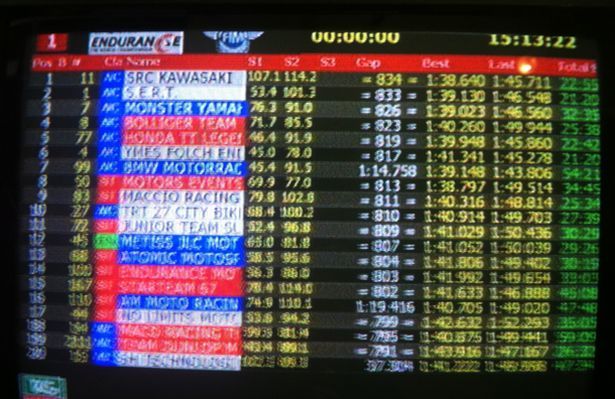
The next few hours alternate between the boredom of staring at the timing screen, and trying to make sense of what we are seeing, and the terror of getting something wrong on the pit stop.
 
But after a few stops we've settled into a rhythm and it's far less stressful. And I'm starting to get the beginnings of understanding the timing screen and how to interpret the numbers.

The sun sets, the lights from the fairground and the huge TV screens are on, pit boards are lit, lights on the bikes are on and the flash teams even have illuminated the numbers on their bikes.

The pit lane is as bright as daylight, the team were right to not bother with a lighting rig, with all of the other team's lighting rigs and the circuit's floodlights.

The lap times are unchanging, despite the darkness out on the track.

Status Quo kick off their set at the fairground, surreal to be catching snatches of “Rockin' all over the world” when there's a momentary lull in track noise.

The track noise is monumental; at any one time there's several bikes on the track howling up the gears as the come out of the last corner and blast up the start straight past the pits, numerous bikes in the pit lane on speed limiter, the warning klaxon is continually sounding every time a bike enters the pit lane, the voluble French commentators on the tanoy, shouted warnings to move as bikes are released from adjacent teams, your own team mates having bellowed conversations inches away from each other and the Dante-an staccato beat of hundreds of spectators bikes all around the circuit being held on the rev limiter for minutes at a time.

The fifth pit stop is despatched with no issues, we appear to be climbing up the order which is encouraging but everyone constantly reminds us novices that it's a long, very long, race and there's still a lot that can and will go wrong.

How prophetic...

Our bike has, obviously, aftermarket rear sets fitted. They're a new design from Arrow that the team have not used before and, to give it the obligatory race shift, the gear lever pivots on a separate bracket bolted to the crank cases rather than on the left hand rear set itself.

Two laps after the bike has been in for its fifth pit stop, about seven hours in and well truly in the night part of the race, the bike unexpectedly appears back in the pit lane outside the garage. Frantic shouting and hand waving and pointing – it is an Italian team after all – ensues out in the pit lane and it becomes apparent that the gear lever is flopping about and the rider can't change gear.

The bike is whisked into the garage, everyone falls on the bike in an unrestrained example of bedlam, the failed gear lever assembly is removed and the one from the spare bike - stripped down in preparation at the start of the race for just this kind of scenario – is hurriedly bolted on and the bike is pushed out of the box, given a quick splash of fuel and roars off into the darkness, having spent about the best part of ten unplanned minutes stationary.

Meanwhile, we gather round to look at the failed part; the bracket is CNC'd from aluminium and the machining has left a stress raiser where the bracket steps down in thickness, which is stressed every time a gear change is made and it's snapped clean across the stress raiser.

The only other spare bracket is checked, it's the same. So it's very probable that the bracket we've hurriedly fitted, and is right now being hammered on the track, is also the same and liable to fail in the same way in the same time frame as the first one.

Unsurprisingly the team don't track and life the parts; as best as we can tell the failed bracket was the one with the least track time before the race, having been fitted to the bike that the riders didn't like as much during practise and qualifying, and looked to have failed after about eight hours use.

The bracket that's just been fitted is the one that had been used for most of practise and qualifying and has at least four hours track time on it.

Hurried maths ensues; there's seventeen hours of the race left, there's one bracket with an estimated four hours of life left in it currently fitted to the bike on track and there's a brand new, unused, spare in our hands with about eight hours of life. Shit. We're five hours short.....

So there's two problems to solve; how to make it to the end of the race and what strategy to adopt – fit on failure and lose more time due to unplanned pit stops or pro-actively change the bracket before it can fail, based on some pretty sketchy data?

Various team members are despatched up and down the pit lane to find the garages where teams are running the same model GSXR as us to see if they have anything in the way of parts that we can beg, borrow or steal.

In the meantime we take a look at the spare bracket and try to come up with a way of making it last longer. Tools that would be of any use are in short supply. But what we do have in large quantities is chemical metal; normally used for hurried repairs on crashed engine covers and the like.

The magpies return from their efforts up and down the pit lane, not unexpectedly they've had no luck.

So chemical metal is bodged onto the bracket, on both sides, covering the stress riser in the hope that it will bond securely enough to the bracket – which has been keyed with the only file the team had which wouldn't have looked out of place in a farrier's tool kit for shaping horses hooves – and provide some extra structural strength and extend the bracket's life.

The decision is also made to swap the brackets over at the next pit stop, so that the one on the bike can also be given the chemical metal treatment before it starts cracking and then the plan is to run the zero hours spare for twelve hours and then remove it and put the used spare on for the remainder of the race, keeping the bracket with twelve hours use – and hopefully still unbroken – as a last ditch “Hail Mary” spare.

We make the planned change and bodge the other bracket and then wait to see whether we'll last the distance...

Thick fog is suddenly rolling across the finish line and through the pit lane, I can barely see the stands opposite the garage and the flashing lights from fairground and rock concert are lighting it up like something from “Close Encounters...”. The headlights of the bikes howling up the straight past the pits, with no noticeable reduction in speed, are projecting huge, searchlight like, beams of blinding light up the track.

No, wait! It's not fog, my eyes are stinging, that's smoke, wood smoke! What the hell is on fire to cause that much smoke.

Aah, now it makes sense. The huge piles of pallets have been set on fire.

Apparently there's other parts of the track, unlit, where the riders report they hit the smoke at over 150mph and they can't see anything – the track, other bikes, nothing – for what feels like an eternity before the punch out of the other side and the smoke, even at that speed, makes their eyes water.

So, let's get this straight. The organisers of an international, world championship, race deliberately supply tens of thousand spectators with immense, gargantuan, amounts of flammable material in order that they can set fire to it and make an, already dangerous, event even more dangerous?

There an odd bunch, these French....
 
After a couple of hours the smoke has thinned but it remains visible until well past dawn.

Back to the timing screen.

As part of my visual check of the bike during the pitstops I've been looking at the oil level in the sight glass. This was surprisingly problematic at the start of the night sessions as the clean oil was difficult to see, with any certainty, under artificial light but as the race progressed and the oil started to darken it became easier and it could be seen that the level was slowly dropping between stops.

The oil level has got to just above the minimum mark on the sight glass so it is planned to top it up at the next stop. The oil filler cap has been replaced with an aero-quip style, quick fill, adaptor and the team have an oil filler that is pressurised with an air line and forces a measured half liter of oil into the engine.

“Mark” takes responsibility for the oil fill.

And makes a total horlicks of it, spraying oil all over the bike when he fails to engage the nozzle and fitting correctly before pulling the trigger and half a litre of pressurised oil goes everywhere except inside the engine.

The bike can't be released like this.

The belly pan is whipped off and four grown men with the “mechanician” armbands fight over a roll of blue paper towel and a can of brake cleaner to attack the bike and get rid of the oil.

The crew chief grabs the oil filler from “Mark”, muttering some mighty impressive Italian swear words at him, and legs it in to the garage to fill it back up with oil and pressurise it.

The engine is topped up with the oil being inside the crank cases this time, the bike hasn't – against all the odds – caught fire despite the best part of a whole can of brake cleaner being sprayed on a red hot engine and exhaust and the belly pan is refitted and the rider heads off into the dark again.

Back to the timing screen and the racing rolls on.
 
The garages at the Bugatti Circuit have several floors of executive boxes on top of them, and the windows that look out over and down into the pit lane slope outwards so that each floor has a clear view downwards, and then on top of the boxes is a public grandstand, with very steeply raked rows of seats, capable of holding many thousands of people. It's a huge complex, the grandstand bottom row must be sixty feet up from the pit lane.

Image


It's about two in the morning, were starting to get prepared for our next pit stop due in about 15 minutes, when there's a sudden flash of a body falling, head first, into the pitlane, crashing through the lighting rig of the next door garage, and there's an almighty, sickening, thud which momentarily cuts through the cacophony of the pit lane.

There's a body lying, in a growing pool of blood, in the pit lane 20 feet away from where I stand outside our garage.

For a second no one moves.

I'm the closest to it and run over to the body. It's a man, face down, unconscious, limbs at unnatural angles, clear fluid coming from his nose and ears, his head is obviously deformed and there's large amounts blood leaking out from underneath him.

I kneel by him and check for a carotid pulse while screaming for a medic. The cry is taken up by hundreds of people up and down the pit lane, the officials are all on their radios.

I've got my head down by his and I can hear faint groans from him. He's got an irregular and faint carotid pulse so, based on years of occupational first aid courses in the army and the railway, I don't try CPR or moving him because professional medics are seconds away and there's a real risk I'll just make things worse.

After what seems like an eternity (as an experienced racing journalist, who was standing close by, remarked later “they're quick enough to get people there if, heaven forbid, you've got the wrong pass on...”. Which is a little unfair, everything for medical team is geared up for dealing with on track incidents, not in the pit lane) many medics come running down the pit lane with kit bags and a trolley and take over, so I get up and head back over to the garage.

Our crew chief gathers all the pit crew around and is very clear, the riders are not to be told what has happened. It will mess with their concentration and this is dangerous for them, racing as they are.

We carry out the planned pit stop in a daze, the rider weaving his way through the battle scene of the crowd of medics and officials gathered the round the body and the mangled remains of next door's lighting rig to get to us.

A few minutes after we complete the pit stop the medics have the body on the trolley and head off toward the medical centre, carrying out CPR and with him on an ambubag to breathe for him.

We off the team the next door, who are frantically trying to clear the mangled remains of their lighting rig away from the front of their garage, the use of our fuelling rig and pit lane space to carry out their next pit stop, due in minutes, but they manage to create enough clear space outside their garage to carry on as normal.

I sit down on my own, as far away from everything going on as is possible in the circumstances, and have a few minutes to get my head together and then it's back to it....

A few hours later a gaggle of officials and police came to pit and speak with Moreno and then Moreno speaks to us.

The faller was dead, he was declared brain dead at the local hospital. We were not to talk to anyone about it, if we did the team would never be allowed to race at Le Mans again. (note: I think 9 years passing is long enough to tell the detail and it has been discussed, in less detail, on other forums before).

As best as they could tell, or were willing to say, it looked like he was drunk and fell out of the grandstand, probably leaning too far over the rail to watch what was happening in the pit lane.

There was no ID on the body. They were going to have to wait until someone reported him missing.

Grim.
 
Next pit stop was the front brake caliper change. Thanks to some solid spannering by “Suspensionsmith”, with a nifty Makita right angle impact driver – or “dee radddle gun” as they were all called by the Italians – the calipers were swapped swiftly and without any problems.

Back to the timing screen.

Next pit stop and I spot that two of the three Dzus fasteners holding the belly pan – the same belly pan we had to remove and refit to clean all the spilled oil up – are missing on one side of the bike.

I point at the release man and, in my best parade ground bellow, let rip “NO!”.

No one else on the team has seen what I've seen so they think I've lost the plot when I run into the garage, drag the spare fairing panels out and start stripping the Dzus fasteners from them and then run back to the bike, shove them into the crew chief's hand and point frantically at the holes in the fairing where they should be. I can't fit them myself because I've not got a “Mechanicians” armband and they won't put the bike in the garage, so I can fit them, on my say so alone so he's got to do it.

The penny drops, he fits them and gives the release man the thumbs up and then gives me a thump on the back by way of thanks.

Back to the timing screen.

The safety car is out, there's been a multi bike crash on the far side of the circuit and there's debris all over the track, Moreno immediately wants a pit stop.

This is where my lack of Endurance racing experience lets me down, I don't fully understand the reason why but we don't lose any places if we do this. As best as I can figure out it's because the safety car is a long way behind us on the track and so long as we can get back out before the safety car comes past the pit lane exit it's effectively a “free” pit stop with no time penalty as we can then ride like the clappers, legitimately, to get round to the back of the queue of bikes behind the safety car while everyone already behind the car rides at the regulated pace. Lots of teams are taking advantage of this, so it obviously is a “thing” in endurance racing.

The pit stops goes well, despite the lack of notice, and the safety car is back in after a few laps.

Chef's been banging out food for everyone throughout the race, as well as looking after the riders well being, with people either nipping up to the paddock for a quick change of scenery and the chance to sit down and eat a proper meal or grabbing one of the baguettes or bits of chicken and the like that he brings down to the pits at regular intervals.

About four in the morning Chef appears in the garage with a slew of mugs and a large, obviously hot, saucepan with a ladle.

He starts ladling the contents of the pan into the mugs and there's a nigh on stampede from the Italians to grab a mug from him. It's hot chocolate, and not just any hot chocolate but the darkest, deepest, probably booze enhanced, hot chocolate I've ever experienced. I manage half a mug and then I start getting heart palpitations and head shocks. Wow. Maybe I'm diabetic and hadn't realised?

Back to the timing screen.

It's now just before dawn, the stands opposite the pits are empty apart from a few hardy souls, it's as cold as a witches tit, and it's what feels like our millionth pit stop and the rider coming off the bike is having a longer than normal hand over with the new rider. He's making the official international gesture for winding the throttle on and the bike misbehaving. But the new rider seems happy to take the bike out so there's no time lost.

Moreno, “Inch” and the crew chief are deep in discussion with the rider who's just come off and it appears that the bike has developed a misfire or stutter coming out of slow speed corners at low rpm.

My money, not that they've asked me, is on the throttle position sensor or the inlet air temperature sensor and the consensus amongst the Italians is that it's not bad enough right now to do anything about until, possibly, the next pit stop.

We get the complete air box and throttle body sub assembly from the spare bike ready, in case we need to swap them over. But that's going to be a good twenty minutes worth of work so there needs to be a compelling reason to make the swap.

The moment the bike comes in for the next pit stop “Inch” has the laptop hooked up to the logger and is pulling the logged data off, he unplugs and runs to the garage while the pitstop starts and progresses as normal.

Meanwhile “Inch” is trying to see whether there's anything logged to confirm the problem and what is causing it.

The bike is held in the pit lane.

Unsurprisingly, given the limited number of channels being logged, there's not and there's a hurried conflab between Moreno, “Inch”, the crew chief and the riders before Moreno makes the decision to leave the bike alone and let the riders deal with it, principally because it doesn't appear to be affecting lap times and the riders don't think it's getting any worse.

The new rider jumps on and yet again roars off down the pit lane, bouncing off the speed limiter.

We gather round the timing screen again.

As the sun rises it gives everyone a boost of energy, but it's incredible to think there's still more than eight hours of racing left, even though it feels like we're on the final stretch.

Pit stops carry on, we swap the gear lever bracket as planned, and the screen continues to have everyone's attention.

We are all numb, exhausted and sluggish.

The misfire is still there, but not getting any worse. We're putting in 22 litres of fuel, give or take, every stop.

The stands are slowly filling as last nights party casualties cautiously surface, the sun is shining and the commentators seem to have found new levels of energy and excitement.

It starts to become apparent, around noon, that our pit stops and the race finish aren't going to align, even if each of the remaining stints are stretched by a few minutes to eke every last drop of fuel out of the tank we're still going to come up 15 minutes short.

So we, along with several other teams, have to do a last minute “Splash and dash”, leaving the same rider – our fastest – on board for the last sprint to the line.

With five minutes to go the stands are heaving, the fences round the circuit are in imminent danger of collapse as the obligatory track invasion revs up and the commentators are at fever pitch as it's looking almost certain there'll be a French team finishing first and second.

Pretty much everyone from every team has climbed on the pit wall and is hanging over the track urging their rider on with cheering and shouting and waving arms and clenched fists for the last few moments before the klaxon sounds.

SRC Kawasaki are first over the line after three o'clock and SERT finish second, a lap down, a few seconds later.

I'm not on the pit wall.

It didn't seem right to me, to be celebrating when someone died in the pit lane a few hours ago. I'm standing alone in the pit lane by the already fading dark stain on the concrete where the mystery faller's life blood ran out of him.

I'm not religious or spiritual in any way, but I spend a few moments in quiet contemplation thinking on how fragile life can be before I join the team as the bike comes back to the garage. The track invasion is in full swing by this time and it's a race to get all of the bike, kit and team into the garage and the doors shut before the ravaging hordes steal anything that isn't nailed down in pit lane.

The Italians want to start packing up the bikes and garage right now.

Bollocks to packing up, me and “Suspensionsmith” head out of the circuit to the bar just outside the Musee entrance with the sole intent of getting pissed. And we succeed. Mind you it didn't take much as we were so tired, after 32 hours on the go, so a couple of beers and we stagger back to the paddock, climb into the camper van and pass out.
 
During the race we consumed.

Over 400 litres of fuel. 380 of them in the bike and 30, or more, spilled over the pit lane

1 litre of engine oil. ½ a litre in the engine and ½ a litre on the engine.

18 rear tyres. Most of which Bob will be selling to unsuspecting track day riders within the week.

18 front tyres. The same...

4 front brake pads.

So what did all that get us?

Image


17th overall.

8th Superstock.

799 laps completed.

14 laps behind the class winning Superstock machine and 35 laps down on the overall winners.

Our best lap of the race was 1.42.6.

By comparison, the fastest Superstock lap of the race was 1.38.8 (which, in itself, is amazing as that's only .1 off the fastest full fat Superbike lap time), so we were nearly 4 seconds a lap off the class winners pace and had actually got slower, in comparison to the competion, over the course of the week.

The bike was in the pits in total for a gnat's chuff over 35 minutes during the 24hrs. SERT, as ever the masters of keeping pit time down to a minimum, spent the grand total of 21 minutes in the pits.

By comparison, the winning superstock team spent only 20 seconds fewer than us in the pits.

What does all that tell us? As far as I can tell we were significantly slower on track than we should have been but this was offset by our need to make fewer planned stops and, when we did stop, being sharp and quick on our planned stops.

It looks likely that with the fuelling fiasco, the unplanned stop for the gear lever bracket breaking and then several longer stops to swap the brackets over, replace the missing belly pan fasteners, clean up after the fucked up oil top up and do the data download for the misfire, we probably had a total of 12 minute's worth of unplanned or longer than planned stops.

Without those lost 12 minutes we may have got another 7 laps in, moving us up to 11th or 12th overall and possibly on the podium for the Superstock class.

But, as the saying goes, “If we'd had ham, we'd have had ham and eggs....if we'd had eggs”. We got the result we got with the events that happened....

The gear lever brackets didn't break again, our chemical metal bodge appeared to have done the job.

To finish at all was a testament to the inherent reliability of the Suzuki engine, particularly when Italians don't fuck about with it, being able to cope with the demands it had heaped on it.

To finish where we did was a testament the tenacity of the team members to overcome all manner of adversity – some of it self inflicted but others that no team would ever expect to happen - and the 3 riders ability – despite not being the fastest – to bang out consistent laps, nearly 800 of them, for 24hrs.

It's also a testament to Pirelli's tyres that they gave no concerns whatsoever, depsite the massive temperature range they had to operate in between day and night, and never failed to deliver grip in abundance.

And what did I get out of it?

It was an experience; an exhausting, emotional, eye opening, educational, traumatic, “once in a lifetime” kind of deal.

I've met some truly great people, “Suspensionsmith” is a true star and a friend to this day, and some not so great.

I was told by Moreno, via the crew chief, that I was welcome to come back and work with them any time I wanted.

I'll leave you to guess how many times I've been back....


Postscript:

No Limits are still racing in WEC in the superstock class, still running Suzuki's , still managed by Moreno and still getting similar kind of results.

After getting home I found out that I wasn't the only person to experience the same with “Mark”, finding out after they got to a race to “help” that they were expected to pay for the privilege of being there.

As far as I know “Mark” is no longer involved, in any way, with any form of bike racing.
 
Great stuff, got to page 22 last night and just finished reading now - more pictures on long posts please 🤣
Thanks for sharing.
😊👍
 
Back
Top Bottom