Clutch fluid black

SHarper

Elite Member
Subscriber
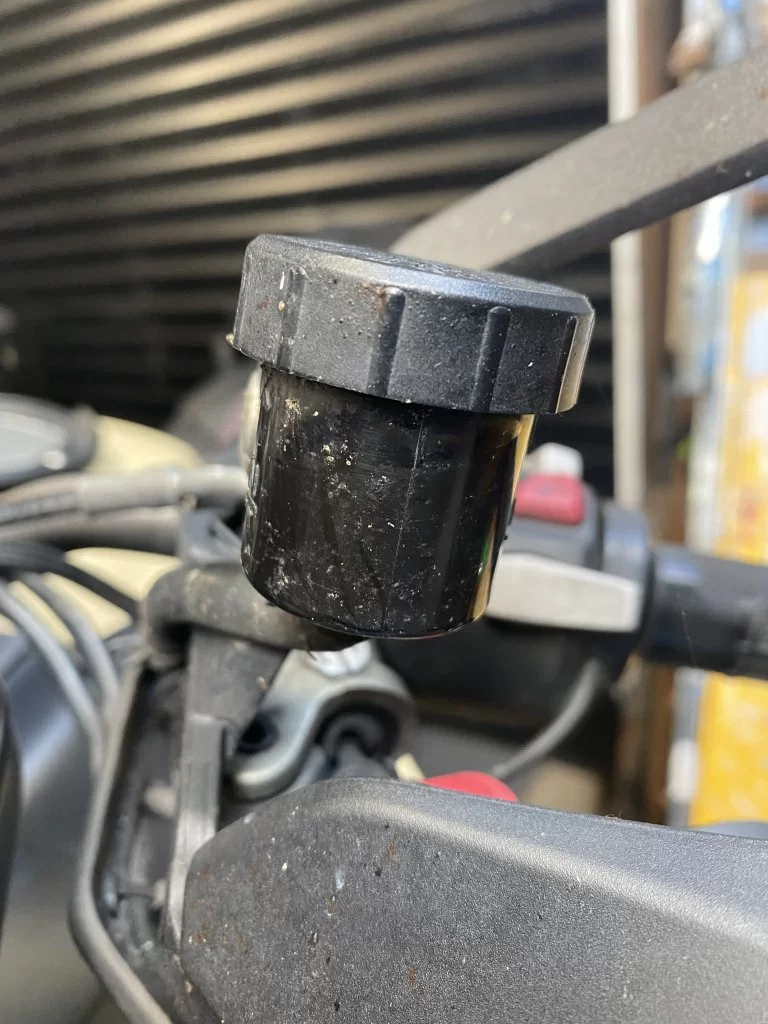
I’ve just noticed that the clutch fluid in the reservoir has turned black. I’m pretty sure it didn’t used to be black, does anyone have any idea why it might have changed?

9A3B6B72-1389-4339-98E7-A7A3ECF0F025.webp


Do you think I ought to just flush it through or does it require a more in depth examination by someone more experienced in these matters?
 
I’ve just noticed that the clutch fluid in the reservoir has turned black. I’m pretty sure it didn’t used to be black, does anyone have any idea why it might have changed?

View attachment 59592

Do you think I ought to just flush it through or does it require a more in depth examination by someone more experienced in these matters?
I’ve found on the monster the clutch fluid is slowly going black
think they all do that sir
maybe a sign the cylinder seal is wearing although mine is newish only a few thousand miles on it
 
I’ve just noticed that the clutch fluid in the reservoir has turned black. I’m pretty sure it didn’t used to be black, does anyone have any idea why it might have changed?

View attachment 59592

Do you think I ought to just flush it through or does it require a more in depth examination by someone more experienced in these matters?
IMHO I think it has to do with being DOT4 and fully synthetic, I've not long done the front anchors, strip, clean, flush and new pads.
The old fluid looked quite dark in the reservoir but upon emptying was not much darker tbh, gonna be flushing the clutch system soon. (y)
 
I’ve just noticed that the clutch fluid in the reservoir has turned black. I’m pretty sure it didn’t used to be black, does anyone have any idea why it might have changed?

View attachment 59592

Do you think I ought to just flush it through or does it require a more in depth examination by someone more experienced in these matters?
Yours is very dark, time for a change. What bike is it on? As @Markduc said ⬆️ ‘they all do that sir’, especially on older bikes. Here are my theories, as it pertains to Ducati engines.

Theory 1.
The clutch pushrod has 2 small o-rings about 1/3rd of the way from the clutch slave cylinder ti the clutch itself, these prevent oil leaking out as there’s an oil galley the pushrod channel runs through. They wear with use, after all the clutch pushrod is going back & forth between them continually. Engine Oil (which is black after a few 1000 miles, can then migrate along the pushrod to the clutch slave cylinder (it can, and does go the other way too), where it can get behind the seal and mingle with the clutch fluid slowly contaminating it by way of discolouration.

Theory 2.
The clutch slave cylinder has a dust boot on it. That breaks down with age, rather like the human body it gets floppy & loose with age🤣. Fling from the chain around the front sprocket area gets in there and, as with Theory 1 above, gets on the slave piston and microscopic particles get dragged behind the seal and mingle with the clutch fluid discolouring it.

Or a combination of the two theories.

In olden times you’d never notice as the clutch cylinder was a solid walled receptacle on the bar but as the trend has gone towards translucent plastic remote reservoirs as copied from race bikes the discolouration becomes apparent.

If it were mine, I’d flush it with new liquid, check/replace the dust seal boot and not worry about it too much, it’s only aesthetic and won’t affect the performance in any way👍.
 
My 916 use to do that. Not had another bike since that has. 🤷‍♂️
Did all your subsequent bikes have quick-shifters?

With a QS the clutch push-rod movements are significantly reduced and (see theory 1 above) the life of the o-rings is massively extended.


ps. Now Don’s gonna tell me it’s his 1200 (1260?) Multi and he has a QS which he uses all the time and that will hole my theory 😕
 
ps. Now Don’s gonna tell me it’s his 1200 (1260?) Multi and he has a QS which he uses all the time and that will hole my theory 😕

It’s my 1260 Multi, it has a QS that I use all the time.

Although yesterday when changing using it the bike was bogging down a bit after each change, it felt like a fuelling issue, probably not connected to my Nero brake fluid.
 
Yours is very dark, time for a change. What bike is it on? As @Markduc said ⬆️ ‘they all do that sir’, especially on older bikes. Here are my theories, as it pertains to Ducati engines.

Theory 1.
The clutch pushrod has 2 small o-rings about 1/3rd of the way from the clutch slave cylinder ti the clutch itself, these prevent oil leaking out as there’s an oil galley the pushrod channel runs through. They wear with use, after all the clutch pushrod is going back & forth between them continually. Engine Oil (which is black after a few 1000 miles, can then migrate along the pushrod to the clutch slave cylinder (it can, and does go the other way too), where it can get behind the seal and mingle with the clutch fluid slowly contaminating it by way of discolouration.

Theory 2.
The clutch slave cylinder has a dust boot on it. That breaks down with age, rather like the human body it gets floppy & loose with age🤣. Fling from the chain around the front sprocket area gets in there and, as with Theory 1 above, gets on the slave piston and microscopic particles get dragged behind the seal and mingle with the clutch fluid discolouring it.

Or a combination of the two theories.

In olden times you’d never notice as the clutch cylinder was a solid walled receptacle on the bar but as the trend has gone towards translucent plastic remote reservoirs as copied from race bikes the discolouration becomes apparent.

If it were mine, I’d flush it with new liquid, check/replace the dust seal boot and not worry about it too much, it’s only aesthetic and won’t affect the performance in any way👍.
One other theory Paul is that it is caused by heat from the engine heating up the fluid in the slave.

Every time the lever is pulled the entire volume of the master cylinder is transferred to the slave and back again to the reservoir, so there is a constant movement of fluid between the reservoir and the slave but I'm not sure that any of these theories are the real cause, more likely a combination of them.

An observation I made a few years back when I had an ST4s. I laid up the bike for the winter and the clutch fluid was fairly black. I had the intention of changing it in the spring. Three months later when I was getting the bike ready for the next season the clutch fluid was clear again! I changed it anyway and as always used a syringe to empty the reservoir first. That's when I found all the black as a deposit of particulates on the bottom of the reservoir. This seems to prove that it is largely made up of particles from the seals, probably mainly from the slave. Discolouration of the fluid with time and heat will also be a factor but I don't hold with the theory about engine oil getting into the hydraulic system. If the engine oil can het in the fluid can also get out, you'd be forever topping it up and for the engine oil to be that black the engine would need to really shagged.

None of my current Ducatis have hydraulic clutches, both use cables, but latterly I had been using a synthetic DOT 5.1 fluid, can't remember the brand of the top of my head, and didn't experience the fluid becoming black.

And for what it's worth, for the past 3 years or so I've been doing clutches changes up and down the box all the time, with or without a quick shift. There is nothing to it. I started this because of previous injuries to my left hand that causes me pain when I'm using the clutch a lot. If you think about how a QS works you can do the same thing manually but not quite so quickly.
 
I do love theories , especially about strange things going on ..... I just can't help myself :rolleyes:

I'm going to chuck out an alternative to those mentioned above ....

I reckon that the fluid darkening happens entirely at the master cylinder end of the system .
Either from age-related disintegration of that seal under the reservoir cap , or ( less likely )
the same thing happening to the internal seals of the master cylinder .
A much more likely culprit is that short length of crappy tubing connecting the reservoir to the
master cylinder .

My reasoning is that the clutch fluid never really circulates , it just shunts back and forth in the hose ,
which has a narrow I/D , and must be around a metre in length .
Hand pressure forces a small amount of fluid into the line , and the clutch springs push it back again .

Try bleeding off a bit of fluid at the slave cylinder and compare the colour to what's in the reservoir .

..... but just my 2 escudos worth , as always ....:p


PS. I've experienced the very same thing with dark fluid for 20 years , and I have come to ignore it .

Also , only the clutch fluid in the reservoir is exposed to light .....
but then so is the brake fluid ..... Hmm ........ :unsure::unsure:
 
Last edited:
I must say that its resemblance to liquorice sambuca does bring back some fond memories.

I’ll go and source the bestest clutch fluid I can find on a Sunday.
 
particulates from the reservoir seal and master cylinder seals

Yeah ..... but no ..... but yeah
[ ..... I'm trying to reason my way through this as Vicky Pollard would ...... :ROFLMAO: ]

The more I think about where to put the blame for the particulates , the more I'm liking that runty little tube
between the reservoir and the master cylinder .

Three months later when I was getting the bike ready for the next season the clutch fluid was clear again!

That's a very interesting observation !
To me , it's further evidence that the root cause is particles in suspension , and not any darkening of the fluid itself !

why does it not happen with brake fluid

Good question ...... I'll tentatively offer this , for now at least .....

When you pull on the brakes , there is only a tiny amount of fluid that is moving ( compared to the clutch ) .
There is much less shifting back and forth because there is nothing much pushing back against the slave cylinders .
Assuming the brakes are properly bled , it only needs a small movement of the lever before it feels solid .....
..... which is very different from the clutch action !

Add to this the fact that the brake fluid reservoir is much bigger than the one for the clutch ....
..... so maybe there's a dilution factor at work as well ?

I'll ruminate on this a bit more .......
...... unless I get distracted by another of those fascinating videos about owl stretching .
 
Last edited:
Did all your subsequent bikes have quick-shifters?

With a QS the clutch push-rod movements are significantly reduced and (see theory 1 above) the life of the o-rings is massively extended.


ps. Now Don’s gonna tell me it’s his 1200 (1260?) Multi and he has a QS which he uses all the time and that will hole my theory 😕

Nope, my 996 never used to do it, nor MV Agusta F4 of around the same era.

I put it down to a rubber seal somewhere in the system breaking down (basically because I knew they were black). Maybe the thoughts on the incorrect brake fluid above, could be correct. :unsure:

Pics back in the day weren't very high res, but here you go. 👀

Ducati 6.JPG
 
Last edited:
All my Monsters did this. I went through the whole list - different fluid, different slave cylinders, and none made much difference. Of coures, initially the fluid goes clear, coz you replace it, but in time you will be back where you started. From memory, nothing much worked, but the clutch still worked well, so I would say change the fluid regularly but don't worry about it!

having said all that, I have a horrible feeling that I did solve it, but my memory is shit!
 
I’ve just noticed that the clutch fluid in the reservoir has turned black. I’m pretty sure it didn’t used to be black, does anyone have any idea why it might have changed?

View attachment 59592

Do you think I ought to just flush it through or does it require a more in depth examination by someone more experienced in these matters?
 
Back
Top Bottom