
Electrictrickery question

West Cork Paul

Man in a Shed
Subscriber
Aimed at our electronic gurus here eg @Alan Williams , @AirCon amongst others, can someone please explain something to me, my A-level physics from 40+ years ago is defeated and I just want to understand why.

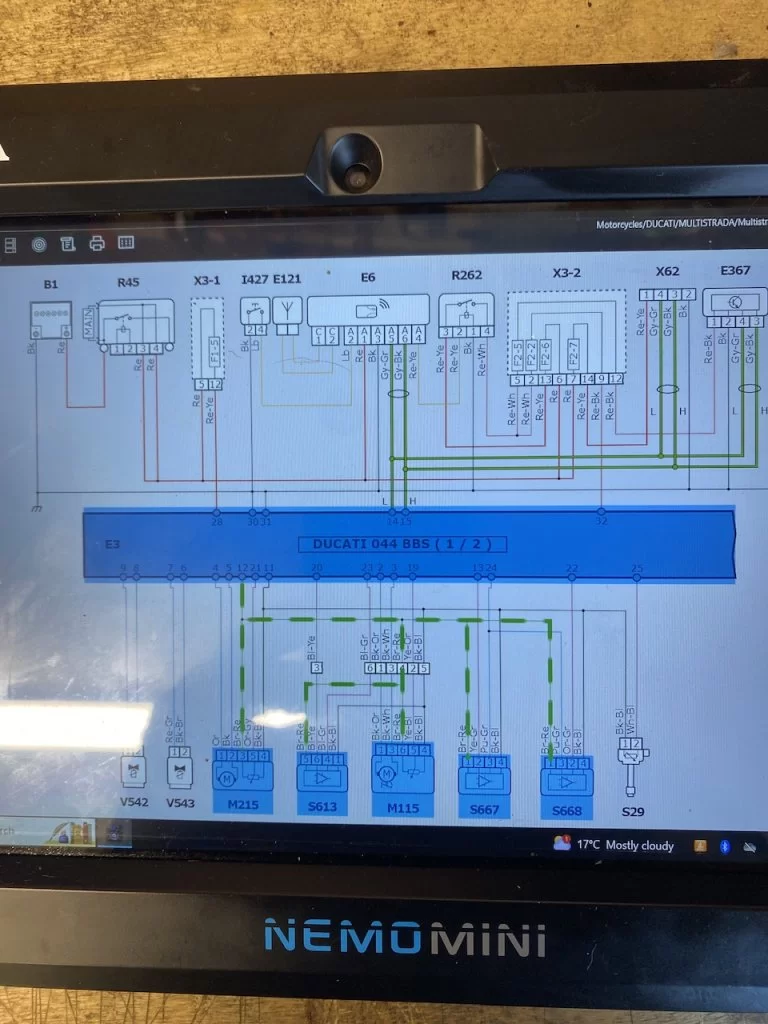
Take a look at this wiring diagram
IMG_6533.webp


The green dotted line is the supply from the BBS to 5 components, being 2 electrical motors (the rear hydraulic preload adjusting motor and the exhaust servo motor) and 3 sensors, being the Skyhook suspension sensors.

As you can see there’s a single supply line coming from pin 12 of the BBS which splits to the various components rather than 5 individual lines. The BBS is supposed to put out 5v to each of those 5 components but there’s a faulty component out there, the rear shock preload adjuster motor, marked M215 in the diagram.

Now when M215 is connected I only get <0.3v at each of the other 4 components, but disconnect M215 and the supply voltage at the other 4 is 5v as it should be.

There’s some kind of fault internally in that motor but what I don’t understand is why that reduces the voltage supplied to the other components 🤔.

Can anyone explain please?

@WAYNE, I bet your Enfield doesn’t have these problems 🤣
 
Water/corrosion within the motor... they aren't normally "just a motor"... they are stepper motors with circuit boards at the end of "the motor"... more accurately they are servos.
 
Aimed at our electronic gurus here eg @Alan Williams , @AirCon amongst others, can someone please explain something to me, my A-level physics from 40+ years ago is defeated and I just want to understand why.

Take a look at this wiring diagram
View attachment 111973


The green dotted line is the supply from the BBS to 5 components, being 2 electrical motors (the rear hydraulic preload adjusting motor and the exhaust servo motor) and 3 sensors, being the Skyhook suspension sensors.

As you can see there’s a single supply line coming from pin 12 of the BBS which splits to the various components rather than 5 individual lines. The BBS is supposed to put out 5v to each of those 5 components but there’s a faulty component out there, the rear shock preload adjuster motor, marked M215 in the diagram.

Now when M215 is connected I only get <0.3v at each of the other 4 components, but disconnect M215 and the supply voltage at the other 4 is 5v as it should be.

There’s some kind of fault internally in that motor but what I don’t understand is why that reduces the voltage supplied to the other components 🤔.

Can anyone explain please?

@WAYNE, I bet your Enfield doesn’t have these problems 🤣
The thing is Paul it does have an ECU and with a suggestion from a member yesterday(cheers who ever it was. (y) ) the timing could be out and it needs resetting, there are no blockages in the system, great spark and an injector that is working a treat with a nice spray that is bang on constant yet it will not start. :rolleyes:, I just get 3-5 engine rotations under it's own steam then nothing so something isn't doing it's job, yesterday i ordered a diagnostic scanner so hopefuly it will tell me whats going on.(y)
 
I’d have said as it’s a common supply M215 has a short circuit, pulling the voltage down.
Yeah, but why? If there’s a short inside the hydraulic unit, which I suspect is the issue, why does it reduce the voltage across all supply lines? Why dont the electrons go ‘

“hmm, I can’t get to the faulty unit because there’s a broken circuit there, well I can get there but I can’t get back so I’m not going. But I can get to other devices and get back so I’m going to go and tickle their fancy still.”

Electrons talk dont you know. I hear them all the time in the workshop 🤣
 
Water/corrosion within the motor... they aren't normally "just a motor"... they are stepper motors with circuit boards at the end of "the motor"... more accurately they are servos.
You are absolutely correct, it’s not just a simple electric motor, it’s actually a ‘thing’ which drives a piston which squeezes the oil which alters the preload. Thank you. But why just because it’s faulty does it reduce the voltage over other circuits which are in parallel not series 🤔
 
With a short circuit the voltage drops because there is a limit to the current that the ECU can supply. If there are wasn't you would get a huge current through the faulty motor and it would result in lots of heat, burning out the motor, probably the circuit supplying it and possibly the ECU as well. You wouldn't want a fire. Not a good situation
 
With a short circuit the voltage drops because there is a limit to the current that the ECU can supply. If there are wasn't you would get a huge current through the faulty motor and it would result in lots of heat, burning out the motor, probably the circuit supplying it and possibly the ECU as well. You wouldn't want a fire. Not a good situation
Makes perfect sense, thanks 🙏
 
Yeah, but why? If there’s a short inside the hydraulic unit, which I suspect is the issue, why does it reduce the voltage across all supply lines? Why dont the electrons go ‘

“hmm, I can’t get to the faulty unit because there’s a broken circuit there, well I can get there but I can’t get back so I’m not going. But I can get to other devices and get back so I’m going to go and tickle their fancy still.”

Electrons talk dont you know. I hear them all the time in the workshop 🤣

It’s more like each circuit tries to stop the gobby electrons (resistance) but the faulty unit wasn’t paying its resistance fighters enough so they went on strike. That circuit then becomes the easiest for the gobby electrons to attack so they all go that way and there’s none left to attacks the other circuits.

I think.
That too makes perfect sense, thank you. Clearly there’s a finite number of electrons.
 
Before you do that have you tried applying heat?
Yes, a hot air gun, 300c. Plus lots of penetrating oil. I’m going to keep on applying the penetrating oil over the next few days, and heat, and penetrating oil immediately after the heat, and so on and so on.

I’m loath to apply a naked flame from the MAP torch so hot air gun it is.

I’ve even applied Crazy Clarkey who can put on a bit of force but even he can’t get it to budge 😕

IMG_6381.webp
 
Now I’ve got to remove the rear shock absorber and guess what ?

This little fecker is seized solid 😡.
View attachment 111997

I’m off to buy a multi-tool and some carbide tipped metal cutting blades, I think I’m going to have to end up cutting through the bolt 😕
Stp 51 and try doing it up then undoing...

Heat it up and then.... freeze spray the bolt.... protecting the arm from freeze spray..
 
The preload cylinder is, in technical terms, considered as an ECU Paul. Although not shown as such on the canbus circuits, it controls most of the skyhook operations. The BBS supplys power and is the canbus portal for sensor and control info, but that cylinder calls most of the shots as far as the skyhook suspension is concerned.
 
The preload cylinder is, in technical terms, considered as an ECU Paul. Although not shown as such on the canbus circuits, it controls most of the skyhook operations. The BBS supplys power and is the canbus portal for sensor and control info, but that cylinder calls most of the shots as far as the skyhook suspension is concerned.
Useful info, and makes sense knowing now what I do, thank you 🙏
 
2017 1200DVT Enduro
Is it the case with these that the head of the bolt seizes to the swingarm, just like in the sssa of the regular 1200 dvt, and it’s not the actual threads that seize?

If so, after cutting the bolt, how would you remove the head?
 
The preload cylinder is, in technical terms, considered as an ECU Paul. Although not shown as such on the canbus circuits, it controls most of the skyhook operations. The BBS supplys power and is the canbus portal for sensor and control info, but that cylinder calls most of the shots as far as the skyhook suspension is concerned.

Yeah, what Nelly says :D
 
You are absolutely correct, it’s not just a simple electric motor, it’s actually a ‘thing’ which drives a piston which squeezes the oil which alters the preload. Thank you. But why just because it’s faulty does it reduce the voltage over other circuits which are in parallel not series 🤔
Sorry, for the sake of clarity what I meant was, although it is shaped like a motor it also has a pcb with semiconductors at one end... hence susceptible to water ingress at a greater degree than "just a motor"
 
Back
Top Bottom