
Brake m/c sizes ??

West Cork Paul

Man in a Shed
Subscriber
When I took the MTS V4 Pikes Peak for a ride the other day one of the other things I noticed was the difference in the feel of the front brake compared to my MTS V4S. The PP lever didn’t have to be squeezed as far towards the bar for the same amount of braking. So, being curious, I did some checking.

Sure enough, out of the box the PP has different compound pads to the V4S (although they’re both HH rated) but then I upgraded my pads when they needed replacing about 7,000km ago so I don’t think it’s the pads (but it might be a contributory factor).

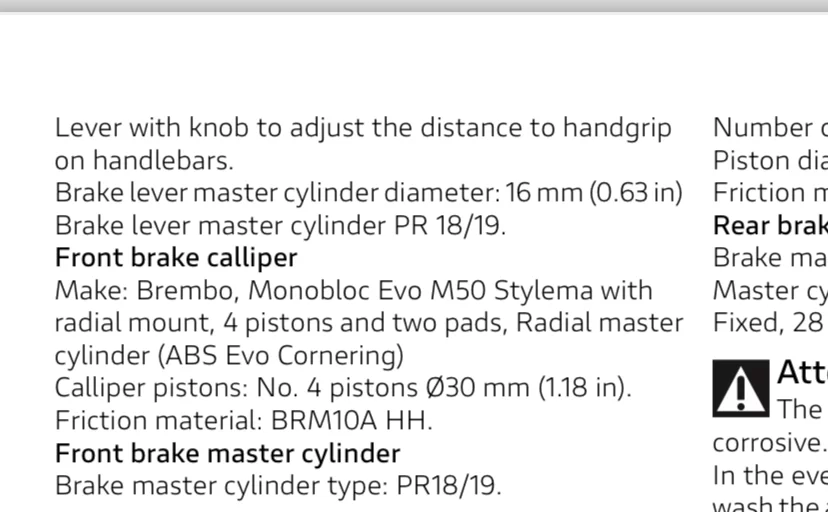
I checked both bikes are fitted with the same master cylinder - they are, but this is where it gets confusing. Here’s the excerpt from the owners manual
IMG_6289.webp

It states the internal diameter of the m/c is 16mm but then states it’s PR18/19. I always thought the first number, ie 18, was the m/c diameter size and the second number, ie 19, the distance between the lever’s pivot point and the plunger - longer gives more ‘sensitivity’ but reduces braking power and vice versa.

So why, in the manual, in one line does it say 16mm m/c diameter but then right underneath say 18mm ? 🤷🏻‍♂️
 
I don't know about that, but isn't your lever adjustable for pressure and pull distance?
 
When I took the MTS V4 Pikes Peak for a ride the other day one of the other things I noticed was the difference in the feel of the front brake compared to my MTS V4S. The PP lever didn’t have to be squeezed as far towards the bar for the same amount of braking. So, being curious, I did some checking.

It will be your 19" front wheel giving the noticeable difference between the 2 bikes 👀
 
I don't know about that, but isn't your lever adjustable for pressure and pull distance?
Adjustable for reach from the bar, yes, but that doesn’t change the pressure (afaik) as the plunger which pushes the m/c doesn’t move, just an elliptical joint which rests against the plunger.
It will be your 19" front wheel giving the noticeable difference between the 2 bikes 👀
Really? Or are you bullsh&&ing? There may be more rubber on a 19” wheel but surely the contact patch with the road will be the same?and as the disks and callipers are the same the braking force required to slow it should be the same. No?
 
  • Useful
Reactions: Dox
Adjustable for reach from the bar, yes, but that doesn’t change the pressure (afaik) as the plunger which pushes the m/c doesn’t move, just an elliptical joint which rests against the plunger.

Really? Or are you bullsh&&ing? There may be more rubber on a 19” wheel but surely the contact patch with the road will be the same?and as the disks and callipers are the same the braking force required to slow it should be the same. No?
I would guess it’s brake gearing, similar to sprocket/drive chain gearing🤷‍♂️
 
Adjustable for reach from the bar, yes, but that doesn’t change the pressure (afaik) as the plunger which pushes the m/c doesn’t move, just an elliptical joint which rests against the plunger.

Really? Or are you bullsh&&ing? There may be more rubber on a 19” wheel but surely the contact patch with the road will be the same?and as the disks and callipers are the same the braking force required to slow it should be the same. No?

It does on my Supersport, and the Triple that Richard was riding the other week 😁
 
Really? Or are you bullsh&&ing? There may be more rubber on a 19” wheel but surely the contact patch with the road will be the same?and as the disks and callipers are the same the braking force required to slow it should be the same. No?
No, it’s leverage innit 🤷‍♂️ same brake set up with a larger wheel = less braking performance 👀
 
It does on my Supersport, and the Triple that Richard was riding the other week 😁
Does it? I always thought Standard OEM adjustable levers only adjust for reach they don’t adjust distance between the pivot point and the plunger or the movement of the plunger in the m/c. By way of an elliptical joint they just move the lever closer or further from the bar but keep the distance from pivot point to plunger constant and the plunger movement is always constant.

To adjust the distance of the pivot point from the plunger you’d have to fit something like Brembo RCS m/c which come with levers that adjust between 18mm and 20mm distances from pivot point to plunger. The longer distance reducing braking power but increasing ‘feel’.
 
  • Like
Reactions: Dox
Does it? I always thought Standard OEM adjustable levers only adjust for reach they don’t adjust distance between the pivot point and the plunger or the movement of the plunger in the m/c. By way of an elliptical joint they just move the lever closer or further from the bar but keep the distance from pivot point to plunger constant and the plunger movement is always constant.

To adjust the distance of the pivot point from the plunger you’d have to fit something like Brembo RCS m/c which come with levers that adjust between 18mm and 20mm distances from pivot point to plunger. The longer distance reducing braking power but increasing ‘feel’.

Ahh, you’re right - it’s only on the Triple that’s got a Brembo mc 👍
 
If the angular momentum is greater on the larger diameter wheel, and this will normally be the case for different sizes of motorcycle wheels, stopping power is effectively reduced for a given braking system.

On the other hand, if you fitted a 26" bicycle wheel, you'd get the wheel stopped pretty quickly compared to a m/cycle wheel.

The diameter of the wheel is only a part of the equation. Angular/rotational mass is what's important.
It's true, here's how Loz worked it out.

Brembo calc.jpg
 
Back
Top Bottom